
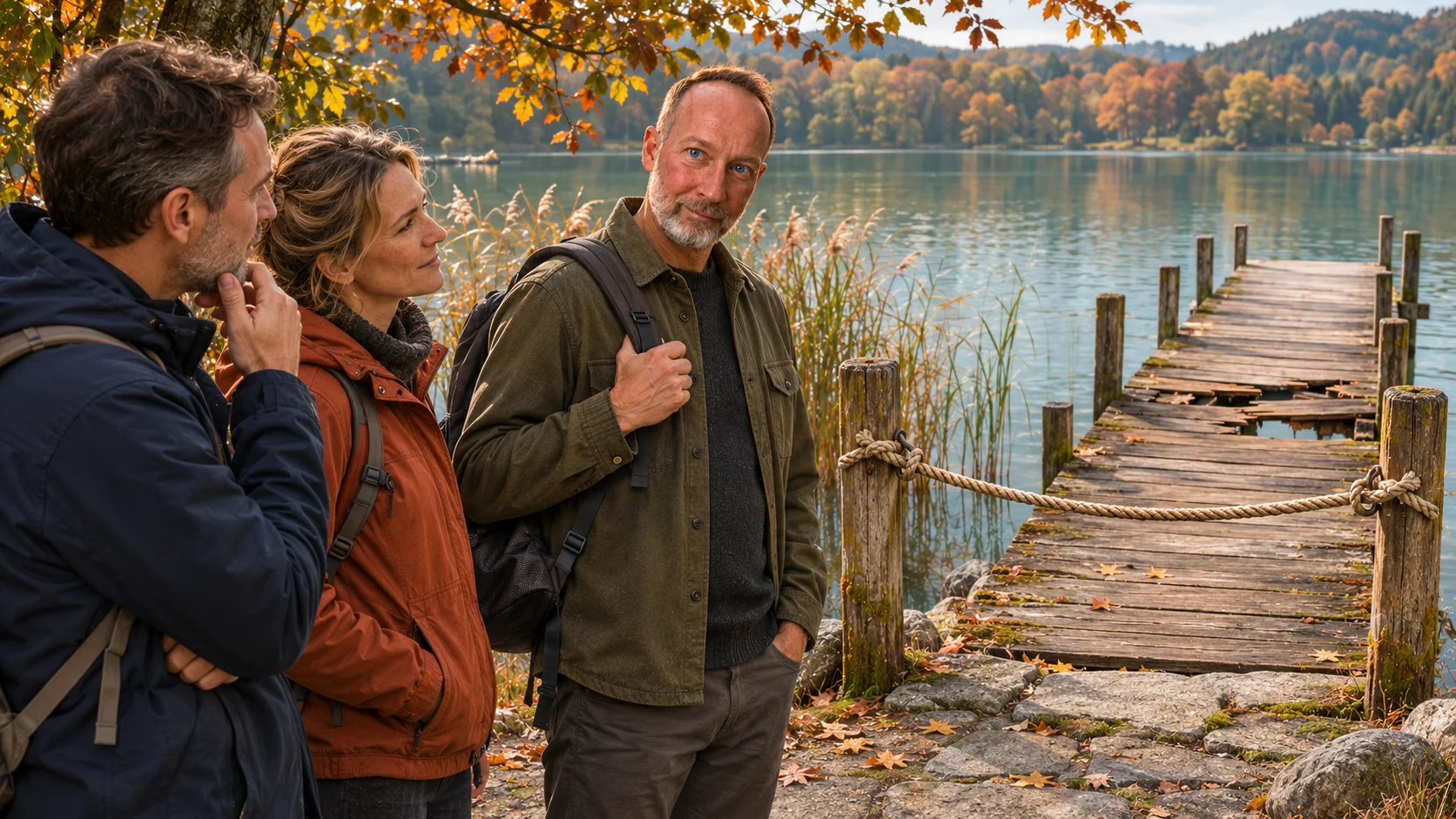
The lake lies still between the trees. Just the right light, Mario thinks. Just the wrong planks, he thinks a moment later. A rope blocks the dock. Farther along, a section of the boards is missing.
Tom stops beside him. “The photo would be better from out there.” He means the end of the dock. Mario has had that thought too. His eyes just happened to take in the hole along the way.
“I'm staying here,” Mario says. Tom raises his eyebrows. “Oh, don't be chicken.” It's a quick remark. It stays with Mario a little longer. Suddenly, beside the broken dock, there's another question: how will it look if he doesn't go?
Sina looks at the water, then at the rope. Nobody is on the dock. Mario holds his backpack strap. For a brief moment, he actually wonders whether taking a few steps would make things easier. Then he looks at the missing boards again.
Two questions at once
Mario is being asked to weigh up two different things: the state of the dock and the worry of looking bad in front of his friends. The comment doesn't make the planks stronger. It only makes staying put more awkward.
Unlike our story “I'm Sitting This One Out,” this isn't just about someone's preference for the evening. Mario can see a specific reason to be cautious: the barrier and the damage. He doesn't have to test whether the dock might hold anyway.
That doesn't mean fear is always right. An uneasy feeling can draw attention to something important, or misread a situation. In this fictional scene, there are visible clues as well. Whether someone calls that chicken doesn't settle the question of risk.
When everyone says something else
In 1955, Solomon Asch reported experiments in which students compared the lengths of lines. Other people in the group had been briefed to give the same wrong answer on certain tasks. Some participants went along with those answers; others stuck with their own judgment.
These were tasks with lines, not trips to damaged docks. The study doesn't show that friends are always pushing us into risks, or that the person standing alone is automatically right. It brings a limited question into view: what happens to our own judgment when everyone else says something different out loud? That's the question we bring into this story.
The photo works from here too
“You can call me chicken,” Mario says. “The dock is still closed.” It sounds less witty than he'd hoped. At least it sounds like his own sentence.
Sina points to a path along the shore. “We can get to the water there too.” Tom looks at the planks once more. Then he turns around. “Fine. But you pick the next photo spot.” No grand apology, no speech. The three walk on.
A little farther along, Mario photographs the lake between two birch trees. The dock stays in the background. Nothing collapses. Nobody gets rescued. His decision doesn't need an accident to have a reasonable basis.
When Tom asks whether the picture worked, Mario checks his camera. “Yes. And my shoes are still dry.” Sina laughs. This time, the remark passes quickly.
Sources: Asch, S. E. (1955): Opinions and Social Pressure [69]. Reviewed by the editors on November 20, 2026; not independently reviewed by subject-matter experts.