
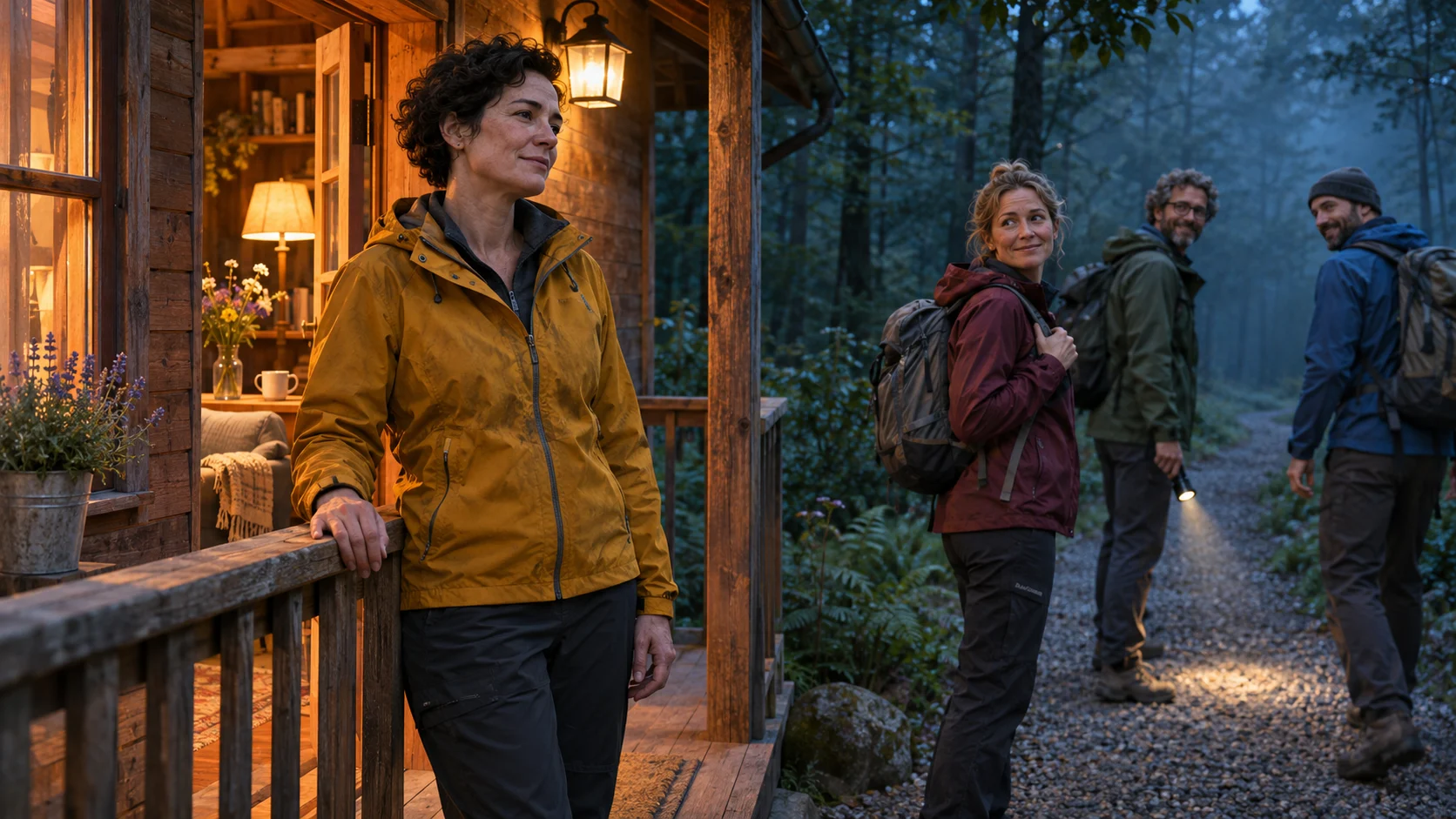
The flashlights are already on the table. One is surprisingly heavy, one has a loose connection, and the third apparently belongs to those things you only start looking for when everyone else is ready. Outside, the forest is turning blue.
Jule has already put on her yellow jacket. At breakfast, the walk to the clearing was a lovely idea. Now she is tired, the path is dark, and what she really wants is to stay on the porch. There is little mystery to the decision. Saying it aloud still carries a weight.
She imagines spoiling the evening. Someone rolling their eyes. “Not today” suddenly turning into “You never want to do anything.” Yet nobody has said anything of the kind so far.
As the others head for the door, Jule puts her hand on the railing. “I'm staying here today,” she says. The sentence sounds smaller than the debate it has just ended in her head.
Belonging and choosing differently
Jule still wants to belong to this group. She simply does not want to join this walk. Both can fit into the same evening. By now, her concern is less about the forest than about her friends' possible reactions.
The term trust here includes the expectation that there can be room for a different wish. That is no guarantee. Friends may be disappointed or ask questions. A relationship consists of more than a smooth reply.
There is also a connection to coping: Jule deals with an unpleasant situation by voicing her decision. This provides no general rule that withdrawing is always helpful or going along is always brave. What a decision means depends on its reasons and circumstances.
When the others already have an answer
Solomon Asch had participants compare line lengths after others in the room had stated their judgments aloud. In certain trials, this instructed majority unanimously gave an obviously incorrect answer. Some answers followed the majority. Other participants consistently maintained their own judgment.
The original historical report covers 123 participants from three colleges. The experiments show that even with a simple task, the social situation can make a difference. However, they examine neither a friendship nor a voluntary outing. Whether Jule wants to go walking today has no measurably correct solution like a line comparison. Asch's findings therefore explain neither her individual decision nor how brave she is. Read the original report [69].
A place stays open
“That's a shame,” Lea says, stopping on the step. Jule already feels a long explanation coming. Then Lea asks, “Shall I put the blanket out for you?”
The others go to the clearing. Jule sits on the porch with the blanket and a cup. For a moment, she wonders whether she is missing something. She probably will miss something. A decision need not silence every other wish.
Later, her friends return with cold fingers and three different descriptions of the same sound. Jule moves over on the bench. “Tell me,” she says. She is happy to join in for that.
Sources: Group influence and personal judgment [69] · Coping [64]. Reviewed by the editors on November 7, 2026; not independently reviewed by subject-matter experts.