
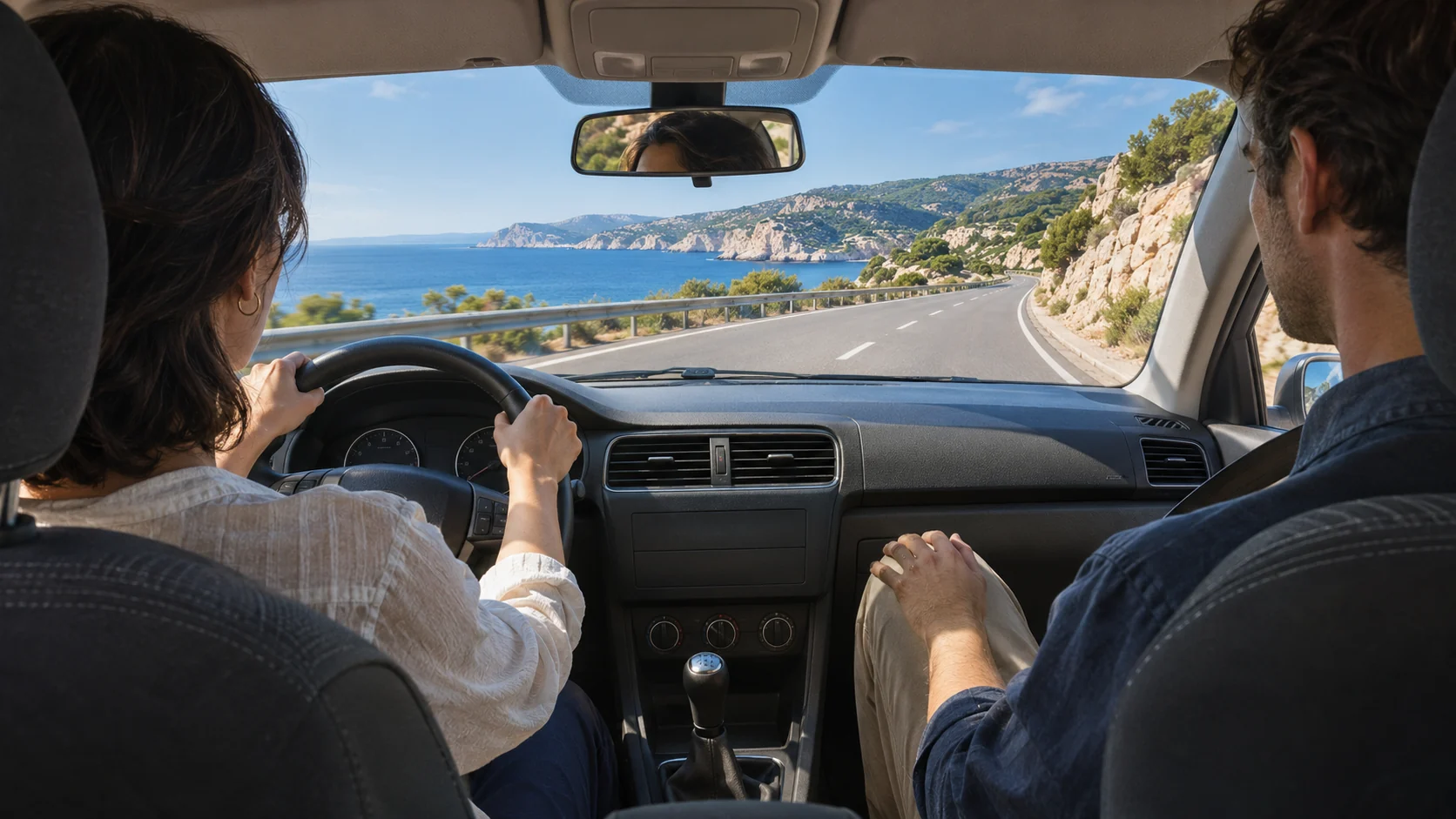
The sea lies far below the road. In the sunlight, it looks almost motionless. Jonas would like to look at it longer. Instead, he watches the next bend.
Mira is driving. They both know this route, and Jonas knows Mira's calm driving style. Still, his right foot briefly presses against the floor as they approach the bend. There is no pedal there. He knows that. His foot seems to insist on a second opinion.
Mira slows down before the bend. The guardrail moves past the window in a smooth arc. A bright strip of sunlight lies across the dashboard. Jonas loosens his fingers from his knee.
“The bend looks tighter from here,” he says. Mira nods without taking her eyes off the road. “We have time.” That is all she says. He is glad it turns into neither a driving lesson nor a joke at his expense.
Beyond the bend, the bay opens up. Jonas now also sees the little white boat that must have been there all along.
Mira, Jonas, and this journey are fictional. The scene represents one possible experience, not everyone in the passenger seat.
Relying on someone without deciding everything yourself
As a driver, Jonas could brake for himself. As a passenger, he lacks those immediate opportunities to intervene. This is a difference in controllability, initially independent of how safely Mira drives. The fact that less personal influence feels unpleasant to him does not automatically make her driving dangerous.
Trust comes into play where something that matters to us depends on another person's actions. Jonas knows Mira and has expectations about her attentiveness. That gives him no guarantee. It gives him reasons to rely on her.
The brief conversation belongs to this story: Jonas can say something without taking the wheel himself. For other people, the same seat can mean relief. Whether someone prefers to drive or be a passenger cannot be deduced from a general statement about fear.
What a familiar person can change
Coan and colleagues studied 110 adults who were told they might receive electric shocks during an MRI scan. They held the hand of a familiar person, a stranger, or no hand. Certain neural responses to threat were lower with familiar handholding.
Reported mood was less negative with a familiar hand than with a stranger's. Compared with being alone, however, this difference was not statistically established; reported arousal did not differ. Brain responses, mood, and arousal are therefore not interchangeable. Original study [33]
A later investigation under modified experimental conditions produced mixed results. Familiar closeness is not a reliable switch for calm. Both studies concern handholding and social support, not trust in driving skills or car journeys. The connection to the story is thematic, not evidence for Jonas's reaction. Later investigation [34]
A little white boat
On the next straight stretch, Jonas mentions the boat. Mira listens. He describes it in greater detail than such a small boat really deserves.
Then comes another bend. This time, his foot stays where it is. The hand on his knee still tightens a little. The sea is still there, and so is the road—and his attention continues moving between them.
Sources: Coan et al. [33] · Beckes et al. [34]. Reviewed by the editors on November 7, 2026; not independently reviewed by subject-matter experts.