
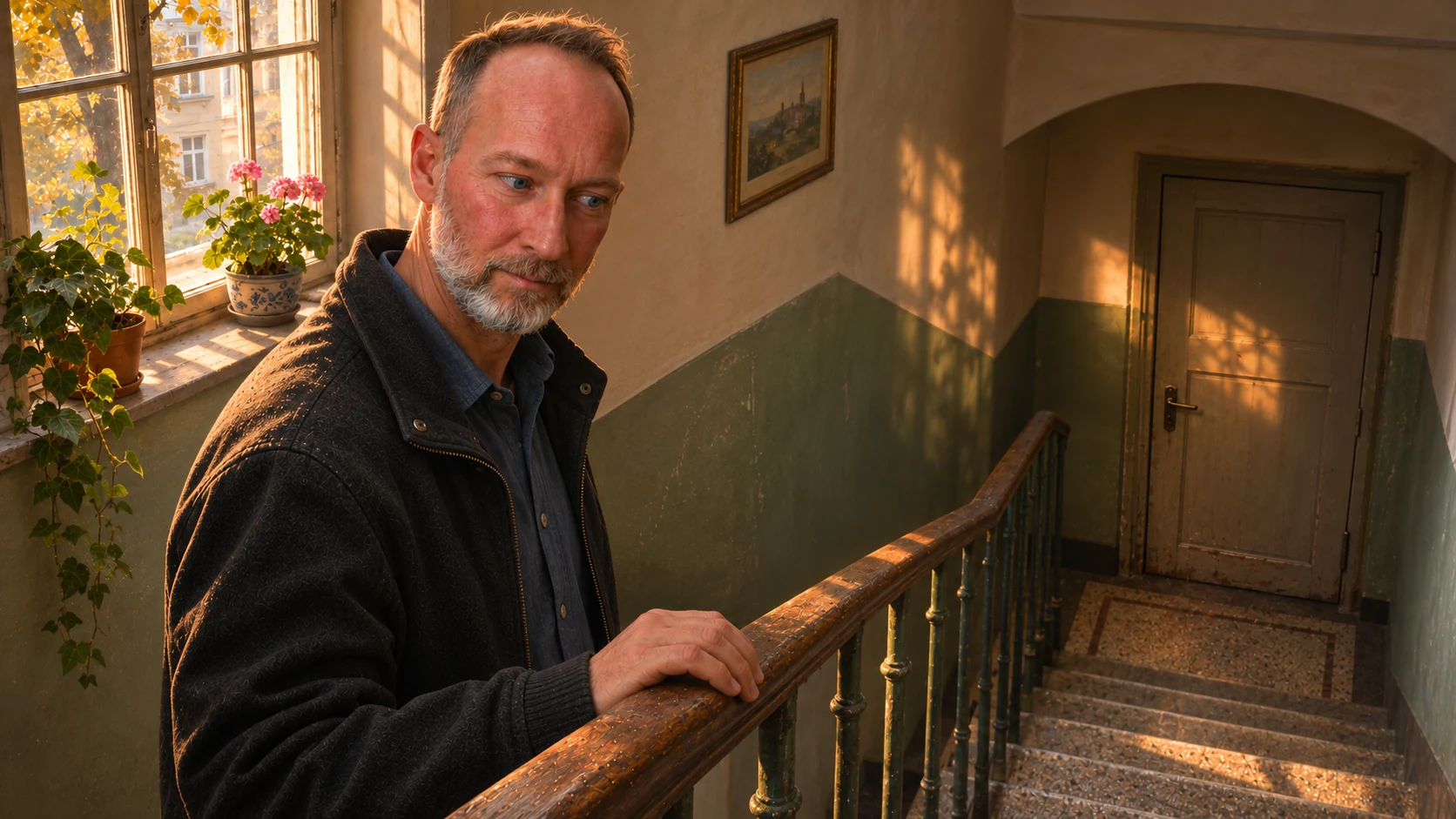
The railing barely reaches Mario's hip. He is certain it used to be higher.
He is visiting the house where a friend of his parents once lived. The current resident is still fetching something from her apartment. Mario waits downstairs. A slanting rectangle of sunlight falls across the terrazzo. Somewhere, dishes clink. It smells of mop water and a lunch that ended long ago.
His gaze travels up the stairs. Here, he used to pause on every other step so that he would not go down too quickly. Now he could cover the whole distance in a few strides. The apartment doors have surprisingly ordinary dimensions, too.
Then he sees the basement door.
The green paint is worn around the handle. A pipe runs above the frame. He still remembers that you could turn on the light down there only after going through the door. Or was the switch outside after all?
His shoulders rise a little. He waits for a sound, though nobody has announced anything. Back then, he imagined what might be standing behind the door. No particular event comes to mind. More like many afternoons drawn together into a single basement door.
From upstairs, the resident calls: “I'll be right there!” Mario looks at his shoes. At least they have become convincingly grown-up by now.
This scene is fictional. Mario appears as a character; the visit and childhood memories are not a reported experience of the author.
A place brings more than its walls
Our autobiographical memory includes individual experienced scenes as well as knowledge about one's own life. “I stood here that afternoon” is different from “I often came here as a child.” In Mario's story, these two kinds of remembering run into each other.
The door becomes a retrieval cue: a present impression brings back something from the past. What Mario sees now and what he associates with the house stand side by side. The familiar surroundings form a context in which the old imagined scene readily returns.
Familiar does not always mean more precise
Jessica Robin, Luisa Garzon, and Morris Moscovitch [43] studied remembering using spatial settings of differing familiarity. More familiar places more often elicited general knowledge and summarized memories; individual episodes arose more often with less familiar cues. Greater familiarity thus did not simply mean more individual scenes.
The investigation does not explain Mario's fictional fear of this door. It helps us see a distinction: knowing a place well and remembering a particular incident are not the same thing. An uneasy feeling alone does not establish a past event.
The railing is still warm
The resident comes down the stairs. “The basement door sticks, by the way,” she says. “In case you were wondering.”
Mario had been wondering about several things. The size of the doors. The light switch. How little a house has to do to send someone briefly back to another age.
He takes his hand off the sun-warmed railing. The door stays closed. They do not need to go down to the basement today.
Sources: Places as memory cues [43]. Reviewed by the editors on November 7, 2026; not independently reviewed by subject-matter experts.