
A shadow outside the door. A sound in the hallway. We have noticed something—but do not yet understand what it means.
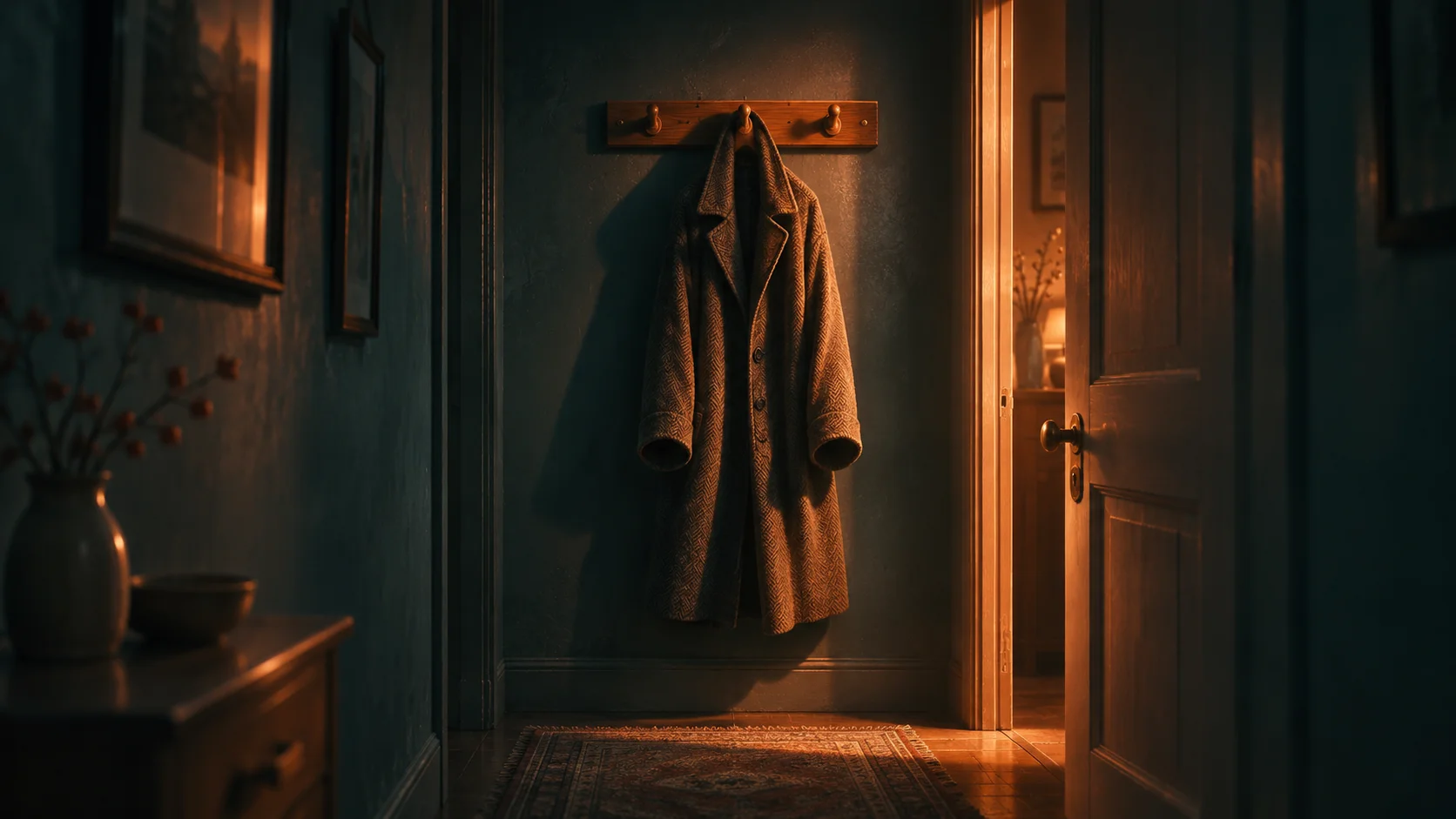
Imagine a dark entrance hall: a coat hangs at the far end. For a moment, its silhouette might look like a person. The following hallway scene is fictional. We use it to distinguish sensory impression, interpretation, and actual danger.
A cue is not yet an explanation.
In our scene, we see a dark shape. “Someone is standing there” would already be an interpretation. Only further information—light or a different viewing angle, for example—shows what is actually hanging there. The distinction is simple but crucial to our question: what have we noticed, and what do we infer from it?
In their model, Mobbs and colleagues describe how organisms explore and evaluate cues to possible threats. This includes assessing danger and seeking opportunities for action. A single cue therefore does not explain the entire response. Background [2]
When details are missing.
In low light, the shape of the coat in our example is difficult to recognize. Collar, sleeves, and hook disappear into shadow. These missing details leave several explanations open. Uncertainty here means that we do not yet know enough about the situation.
Darkness has also been studied experimentally. In a 1998 laboratory study, Grillon and Ameli found an increased startle reflex in darkness. The investigation measured a physical response under specific experimental conditions; it does not establish that every dark environment frightens every person. Study [4]
Our story “Why Does Darkness Frighten Us?” takes these questions into a forest at night.
What do we already expect?
Let us extend the hallway scene: a little earlier, someone said a visitor was coming. The silhouette might now initially seem like the expected guest. After a scary story, the same scene could be told differently.
An expectation concerns what might happen next. In their review, Grupe and Nitschke distinguish several open questions about possible threats: how likely are they, when will they occur, and what will they be like? This uncertainty can make preparing for an event more difficult. The paper brings together basic and clinical research; it does not conclusively explain any single everyday scene. Background [6]
At the movies, this produces an intriguing question: do we want to see whether our guess is right? “Why Do We Peek Through Our Fingers?” tells of this movement between looking and keeping a distance.
The new story “Why Can Waiting Feel Eerie?” stops outside a closed theater door. A sound can be heard; its explanation is still missing.
The same sound, a different frame.
A bang on a theater stage where one has been announced and an unexpected bang in your own hallway are two different situations. In this comparison, context also includes where we are and what we know about the occasion.
In threat research, available escape routes and the proximity of possible danger also matter for understanding behavior. More on this in “Biology & Evolution”. Background [2]
A narrative shift in perspective can, in turn, provide new information: in “How Does a Monster Come into Being?” an initially eerie figure acquires a story of its own.
The story “How Does Fear Find Its Sound?” tells how an image can give a sound a different role—from an empty movie hallway to a fictional sound-effects workshop.
Startling and fear are not the same.
The startle reflex is a rapid, involuntary physical response. The conscious experience of fear and anxiety belongs to a different level of investigation. LeDoux emphasizes this distinction between survival-related systems and subjective experience. Background [1]
For our hallway scene, this means that if someone flinches, we have initially observed a movement. That does not yet fully describe how the person experienced the moment. In the section on physical response and feeling we explore this distinction further.
When the wood seems to look back.

A face in a knot in wood is an example of pareidolia. A shape can seem face-like even while we continue to recognize the object as wood. Background [9]
Our new story begins at a garden gate. It distinguishes the visual impression from the interpretation “Someone is looking at me”—and lets a grumpy wooden resident speak, even though he does not actually exist.
Read the story: Why Do We See Faces in Wood? →
When a view makes you aware of where you stand.
A railing, an expansive view, a suddenly tighter grip: the story Heights & Depths accompanies Mario onto a fictional terrace. The term visual height intolerance helps us ask questions about the experience. The scene remains a narrative.
The related story: Heights & Depths →An empty space invites interpretation.
A chair in a hotel corridor might suggest renovation. Or someone who has just stood up. Which cues we show and which explanation we withhold changes our fictional scene. Context and uncertainty thus become tools of storytelling.
The related story: Abandoned Places →What remains to be clarified?
Our examples make questions tangible; they are not personal tests. Which cues does someone notice? What do they know about the place? What experiences do they bring? Targeted investigations are needed to separate these influences.
We therefore describe possible connections and state the limitations of the sources. A shadow, an expectation, or a loud sound does not by itself fully explain a person's experience.
Sources: LeDoux (2012) [1] · Mobbs et al. (2015) [2] · Grillon & Ameli (1998) [4] · Grupe & Nitschke (2013) [6] · Wardle et al. (2020) [9]. Reviewed by the editors on November 6, 2026; not independently reviewed by subject-matter experts.