
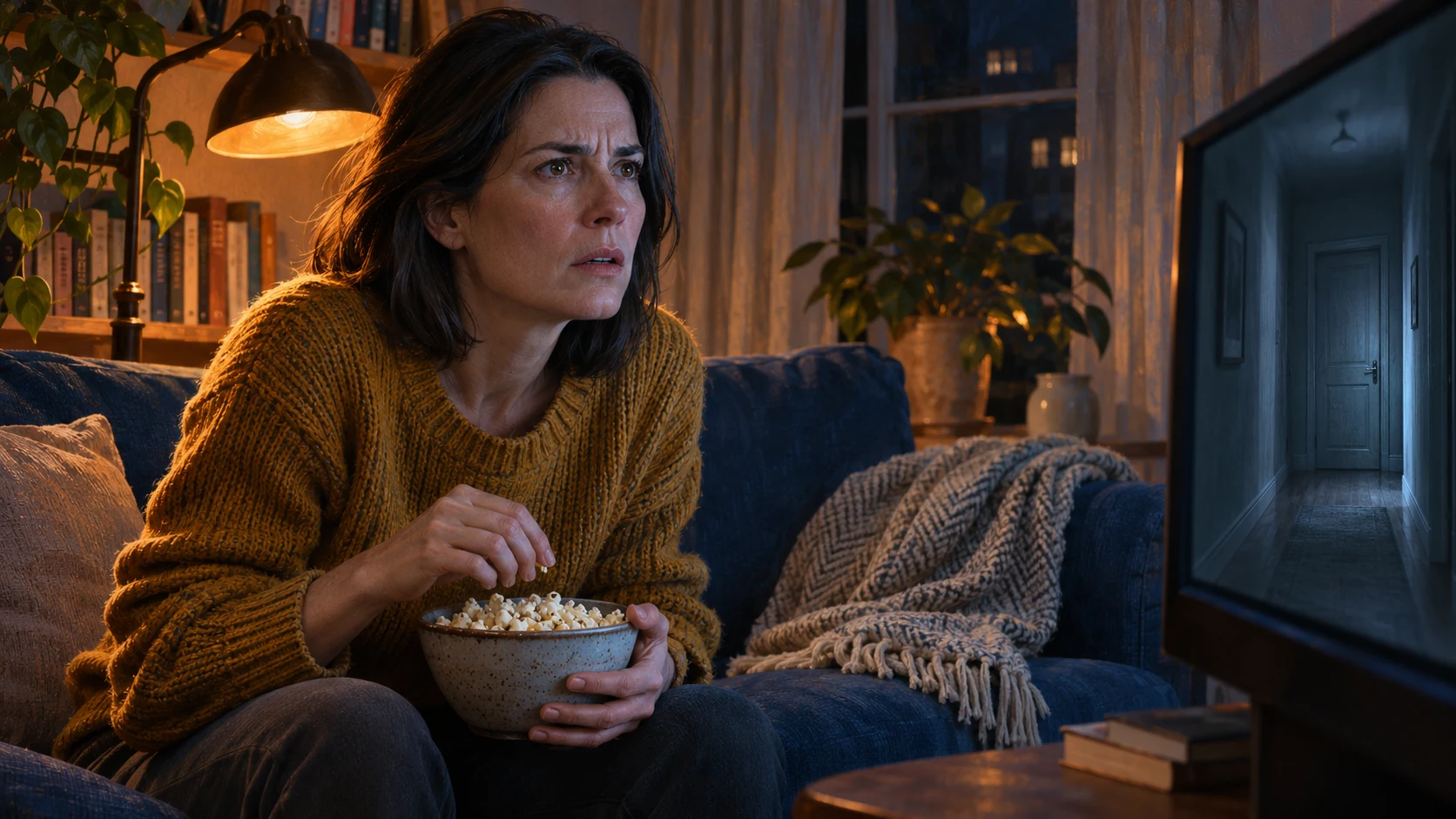
The music stops. Nora notices immediately. Until a moment ago, the movie was telling her quite clearly that something was wrong. Now it seems to be waiting for her to finish the thought on her own.
A hallway fills the screen. At its end, a closed door. No cut. Nora sits a little farther forward on the sofa. Her hand stays suspended above the popcorn bowl.
She knows movies like this. Something is about to happen. Or just when she gives up that thought again. “Come on, then,” she says quietly. The door stays shut. For a moment, only the light from the reading lamp seems to go about its work unimpressed.
This story about Nora is fictional. We stay with what comes before: the scene offers little visible change and a great deal of room for expectation.
Suspense waits for an outcome
Suspense refers to tension directed toward what is coming. Whether, when, and how something will happen may remain open. In their theoretical model, Moritz Lehne and Stefan Koelsch describe such expectations as an important part of experiencing tension. This does not yield a fixed number of seconds that makes every movie scene work.
A subsequent startle reflex would be another level: a rapid physical response to a sudden, strong stimulus. Nora's tense anticipation, her later flinch, and her assessment of time should therefore not be bundled into one single process.
If she later says “It was like slow motion,” another question remains: did the moment feel long, does she remember it as long—or could she actually distinguish faster details? The third claim requires its own test.
A long moment is not yet faster perception
In 2007, Chess Stetson, Matthew Fiesta, and David Eagleman studied a frightening free fall into a safety net. A small subgroup of seven people later judged their own fall to be longer than they had estimated beforehand after watching someone else's fall. Another task tested whether a rapidly changing wrist display could be recognized better during the fall.
This visual task showed no improvement in temporal resolution. The result argues against the simple explanation that an event experienced as stretched out is automatically recorded by a kind of faster internal camera. The authors proposed an explanation involving memory; this does not establish it for every frightening experience.
Such a fall is neither Nora's movie nor waiting for a scare. The study does not measure editing techniques or investigate every possible form of perception. Yet its narrow question is precisely what helps: a later duration judgment alone does not establish perception in slow motion. Nor is every judgment made afterward a retrospective timing judgment in the narrower experimental sense—the crucial point is whether the duration question was announced in advance.
Back in the room
The movie door opens. Nobody stands behind it. Nora breathes out. Then something bangs against the wall somewhere off-screen. Her shoulders jerk up. The hand above the bowl has suddenly become a fist.
She laughs briefly, opens her hand, and leans back. The long silence beforehand was full of possible events. The bang itself was over quickly.
Later, Nora might describe how endlessly the hallway had remained on-screen. Its exact length could be checked in the movie. What she expected during those seconds is not recorded on the timeline.
Sources: Model of tension and suspense [20] · Slow motion and temporal resolution [59]. Reviewed by the editors on November 7, 2026; not independently reviewed by subject-matter experts.