
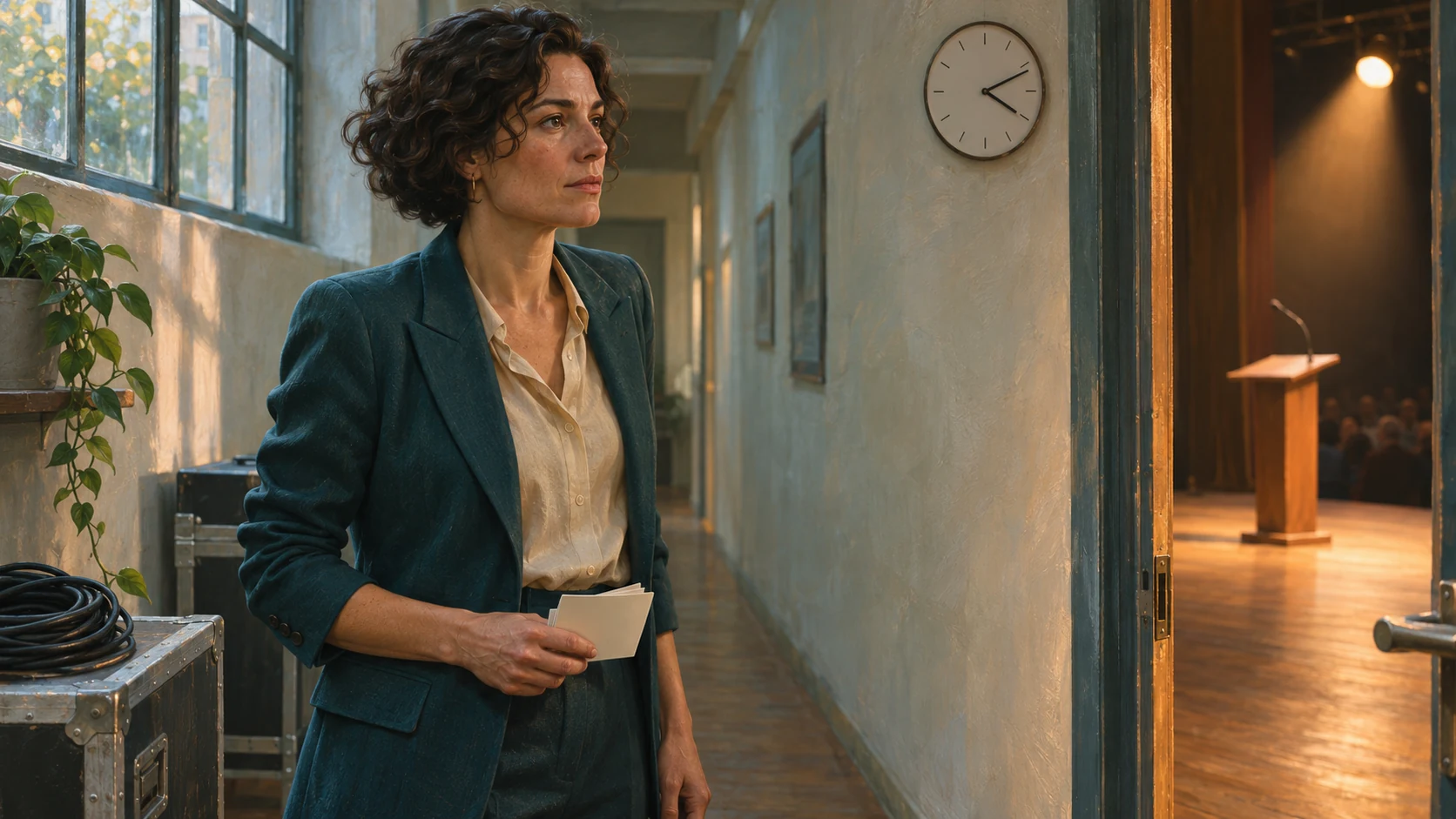
“One more minute,” says the man at the stage door. Jule nods. A minute is not much. When you are changing trains, a minute can even be an outrageously small amount of time.
Here in the side corridor of the community arts center, it suddenly holds a great deal: smoothing the edge of her note card, thinking through the first sentence again, looking at the clock. A single cough comes from the auditorium. Jule raises her shoulders and lets them drop again.
She has rehearsed her talk. Still, she would like to know whether her voice is about to cooperate. Another look at the clock. The hands have barely moved. Perhaps the clock is slow. Perhaps “one minute” means something different backstage.
Jule tries to read on down the card. After two lines, she checks again to see whether it is finally time to begin. This story is fictional. It describes a pause in which waiting itself takes up a great deal of room.
What fills this minute?
Jule's expectation is directed toward the beginning. Because she does not want to miss the moment, she keeps watching time pass. The corridor offers other things, but her attention returns to the open door and the clock.
Research distinguishes between different tasks. In prospective timing, people know before an interval begins that they will be asked to judge its duration. They can therefore deliberately attend to time. In retrospective timing, the question comes only afterward, without prior warning.
Jule's wait is not such an experiment. But the distinction helps us ask a more precise question: is she already watching the minute now, or will she later try to work out how long she was there? Her impression that “nothing is moving” is not yet an estimate in seconds, either.
Attention plays a part. Fear does not dictate a fixed direction.
In three experiments in 1994, Françoise Macar, Simon Grondin, and Laurence Casini studied how the distribution of attention affects judgments of time. When additional tasks drew attention away from estimating time, estimated durations could be shorter. This supports the importance of the particular task; it does not directly measure how agonizing a pause feels.
The formula “more fear means longer time” would also be too simple. Ioannis Sarigiannidis and colleagues had people classify brief image durations as short or long while under threat of unpleasant electric stimulation. Across three experiments, these durations tended to be underestimated under threat. Attention to possible danger and attention to time are not automatically the same thing; however, the proposed attentional mechanism was not directly demonstrated in this work.
The experimental conditions do not fully explain Jule's minute. Her appearance onstage is not an electrical threat, and an estimate of duration is not a direct measure of the felt passage of time. Above all, the studies limit the hasty idea of a single internal clock that always responds to fear in the same way.
Then time has something else to do
The man at the door raises his hand. Jule walks to the lectern. She puts down her cards, finds her first sentence, and looks out into the auditorium. Someone in the front row nods.
Later, the man signals that she should begin wrapping up. Already? Jule had just reached the example she particularly wanted to tell them about. The clock has kept its pace. What occupies Jule has changed.
On the way back, the top card is still neatly aligned with the stack. Only one corner has grown a little soft.
Sources: Attention and time judgments [56] · Anxiety and duration estimates [58]. Reviewed by the editors on November 7, 2026; not independently reviewed by subject-matter experts.