
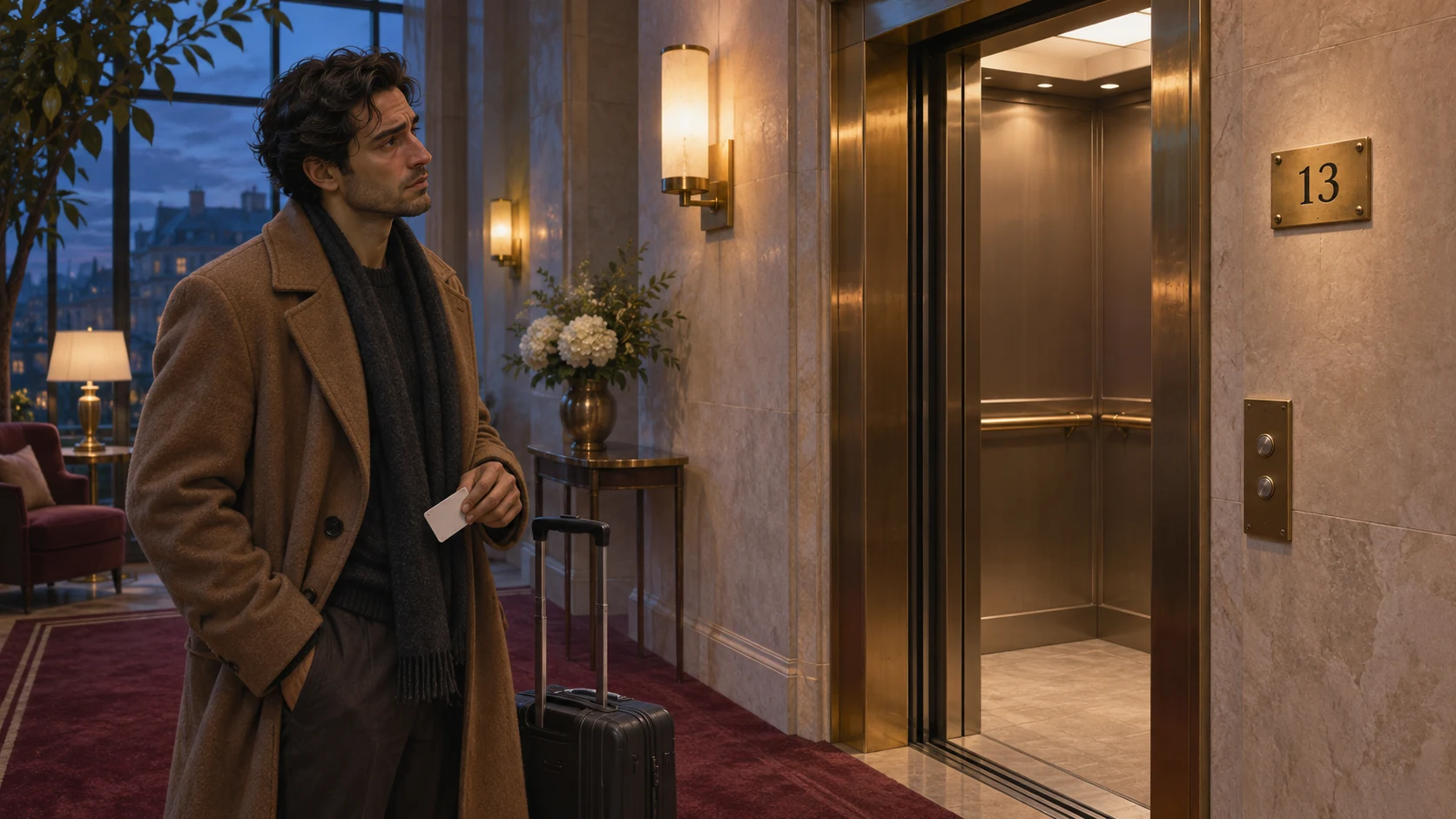
The elevator opens almost silently. Amir pulls his suitcase onto the burgundy carpet and looks for the way to his room. On the left is a small table with flowers. On the right hangs a brass sign: 13.
He stops. Not for long. Just long enough to notice it himself.
At reception, the employee had said “thirteenth floor.” There, it had been information. Up here, in the quiet corridor, the same number suddenly sounds like the beginning of a film.
Amir remembers an evening with friends long ago. Someone had claimed that hotels never had this floor. Someone else had asked where it went if you did not put it on the sign. They had laughed about that.
Now here it is. Perfectly legible, secured with four screws.
He hears a television from one room. Farther down the hall, dishes rattle on a cart. Everything sounds like a hotel where people arrive, eat, and eventually turn out the lights.
Amir looks at the key card. His room is just around the corner. He wonders whether he would have hesitated on the same floor if the sign had said 14.
Amir and the hotel are fictional. The scene describes no actual danger.
The meaning rides up with him
To Amir, the brass sign is more than a number. In the story, it carries a tale he has heard before. The idea of an unlucky number is a form of superstition when the number itself is credited with influencing future events.
But the expectation can also surface without Amir explicitly believing it to be true. “I don't believe in that” and a quick glance over the shoulder need not contradict each other in a fictional scene.
Our section on How We Learn Fear explores what words and stories can do to our expectations. Remembering a horror film is not evidence of danger in the hallway. The context also helps shape how Amir interprets his impressions.
Not every number means the same thing to everyone
Pratt and Kirillova asked Chinese and Western hotel guests about scenarios involving supposedly unlucky room or floor numbers. Depending on the group, these involved four or thirteen. Responses also differed within the groups; most Western respondents had no concerns about thirteen. Read the original study [51].
The researchers collected self-reports, not records of mishaps. Different survey methods also limit the cultural comparison. The results support neither a rule about everyone within a culture nor the conclusion that a room's number determines its safety.
Behind the next door
Amir turns the corner. Nobody is standing outside his door. The key card works on the first try.
He puts down the suitcase and opens the curtain. The last blue of evening lies above the rooftops. A kettle waits on the desk.
The number stays outside on the wall. Amir looks for the outlet.
Sources: The meaning of numbers to hotel guests [51]. Reviewed by the editors on November 7, 2026; not independently reviewed by subject-matter experts.