
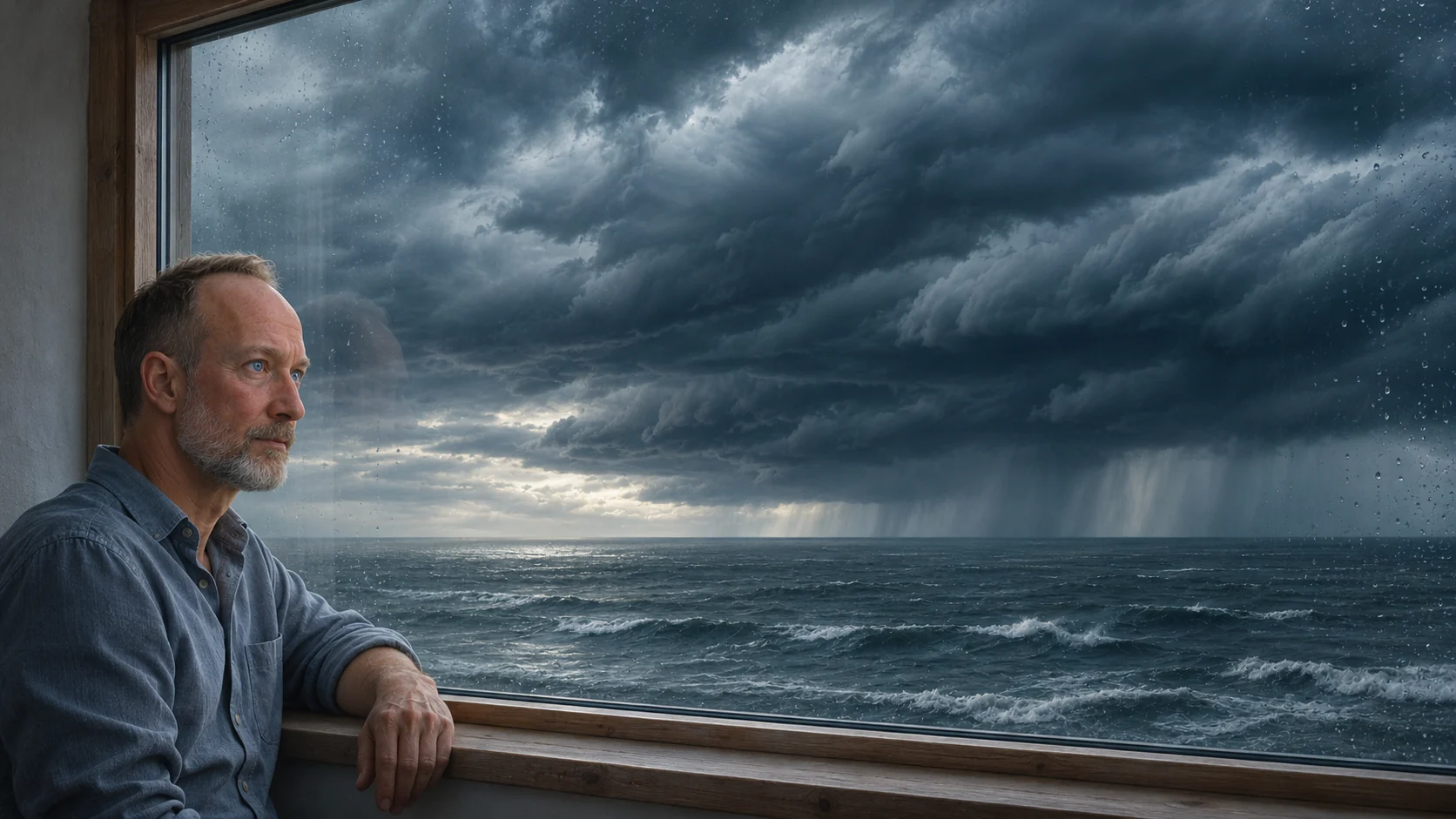
At first, Mario sees only the bright strip above the sea. Then he notices how much darkness hangs above it.
The cloud has no edge where his gaze could comfortably stop. Gray curtains hang from its broad underside down to the water. Farther out, the boundary between sky and sea has vanished.
Mario stands in the living room of a house on the coast. The window is closed. An open book lies on the table behind him. He has not read a line for several minutes.
He wants to show someone what it looks like. His phone lies beside the book, but on its little screen the cloud would probably be just weather. Here, it fills almost the entire wall.
The first thunder is deep and long. Mario raises his shoulders a little. He looks at the window frame, then outside again. The glass gives the landscape a boundary that cannot be seen outdoors.
A bright patch of water appears between the veils of rain and disappears again. Mario finds it beautiful. In this moment, the word feels almost out of place.
He stays at the window. Not quite relaxed. Not ready to sit down again.
A fictional scene featuring Mario as an illustrated character. It does not describe a documented experience.
When wonder is not entirely pleasant
Researchers use a term for this overwhelming sense of wonder: awe. It means experiencing something vast or significant that challenges our usual understanding. It need be neither religious nor entirely pleasant.
The cloud front fascinates Mario and unsettles him. In the story, these feelings continue side by side. The fact that he keeps looking does not mean the unease has already gone.
The darker side of the sublime
Gordon and her research team examined a threat-based form of awe in several studies. It was more strongly associated with fear and discomfort than positively experienced awe. Their methods included recalled experiences, daily-life assessments, and video experiments. Studies [27]
The findings fit the mixture of feelings in our scene. They do not predict how every person will respond to a thunderstorm. Mario's place behind the glass also belongs to the fiction; this particular situation was not tested.
His gaze stays outside
When the rain reaches the window, the distant curtains become individual drops. Mario can count them, but soon loses his place.
The book is still open. The cloud is still there. And for the moment, he wants neither to get closer to it nor to look away.
Sources: Threat-based awe [27]. Reviewed by the editors on November 6, 2026; not independently reviewed by subject-matter experts.