
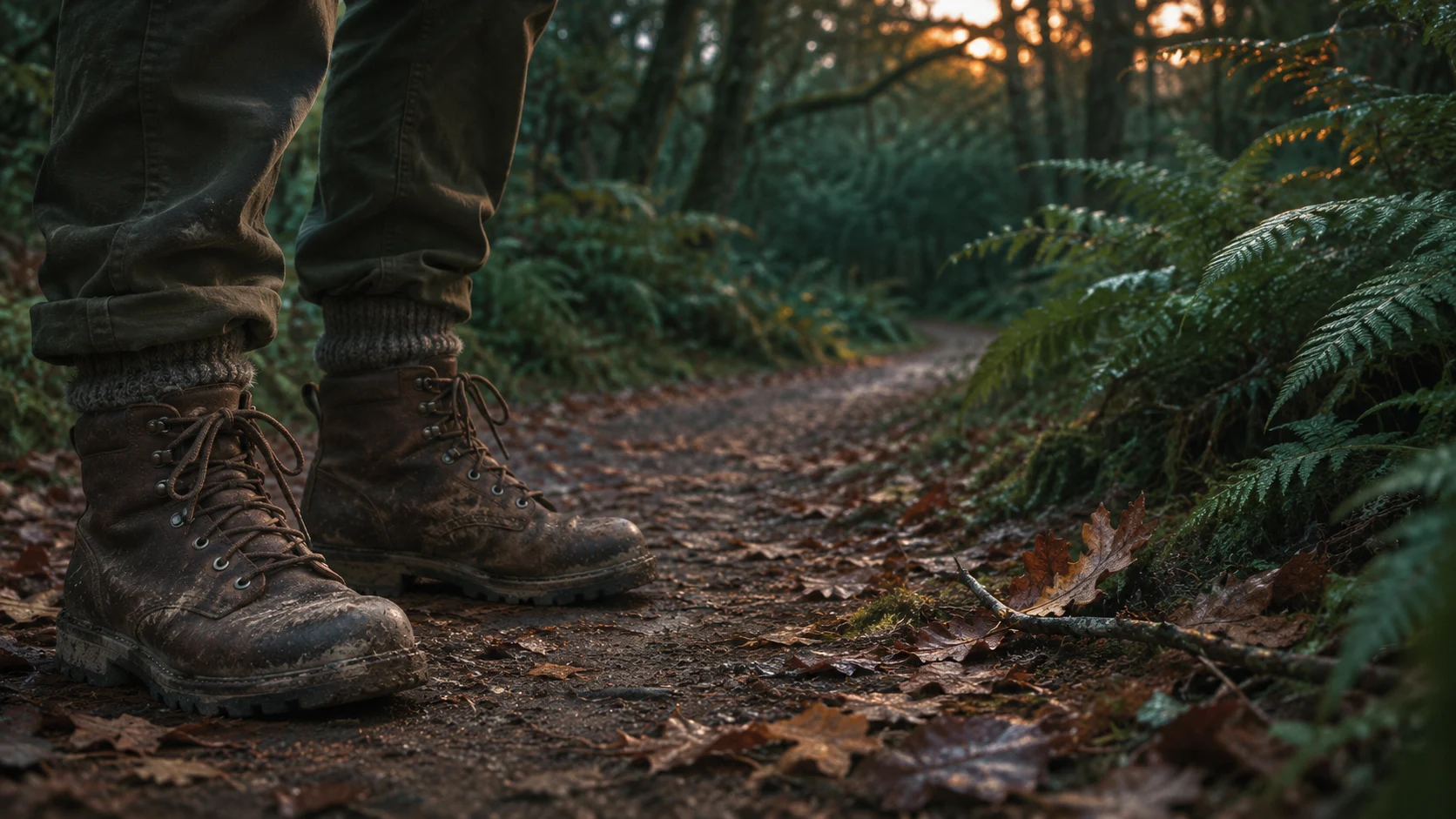
Your shoes crunch along the path. Ferns move to your right. You stop. For a moment, you can no longer hear your own walking.
The scene is fictional: a narrow woodland path in late afternoon, damp earth, leaves beneath your soles. A moment ago, you were thinking about going home. Now you are looking at a spot between the plants.
A leaf gives a last tremble. Nothing else. You cannot tell whether an animal is sitting there or a branch has merely sprung back. The next step might cover the quiet sound. In our story, you wait a moment and listen.
What can be seen from outside?
Someone photographing you captures a person standing on a path. The picture lacks the rustle and your thoughts. Nor does it show whether you stopped deliberately or interrupted the movement without a considered decision.
Here an important distinction begins: everyday stillness cannot be equated, from posture alone, with freezing as a defensive response. Nor can a movement or its absence reveal the entire conscious feeling of fear involved. Background [1]
Readiness can look still.
In her review, Karin Roelofs describes freezing as a defensive state involving reduced movement and often a slower heart rate. This state can support perception and preparation for action. The paper brings together findings from animal and human research. Background [7]
This is not a fixed sequence everyone must go through upon hearing a sound. The situation and available actions matter for understanding defensive responses. Our scene provides neither a measurement nor a diagnosis of the walker. Background [2]
The path continues.
A blackbird hops out of the ferns. It turns over a leaf and disappears among the stems again. You put your next foot onto the path. The crunch returns.
From outside, all that could be seen was a short pause. To understand it, we would need to know more: what was perceived, what movement could be observed, and how was the moment experienced? In the article on biology we separate these questions.
Sources: Roelofs (2017) [7] · LeDoux (2012) [1] · Mobbs et al. (2015) [2]. Reviewed by the editors on November 6, 2026; not independently reviewed by subject-matter experts. Sources & editorial approach