
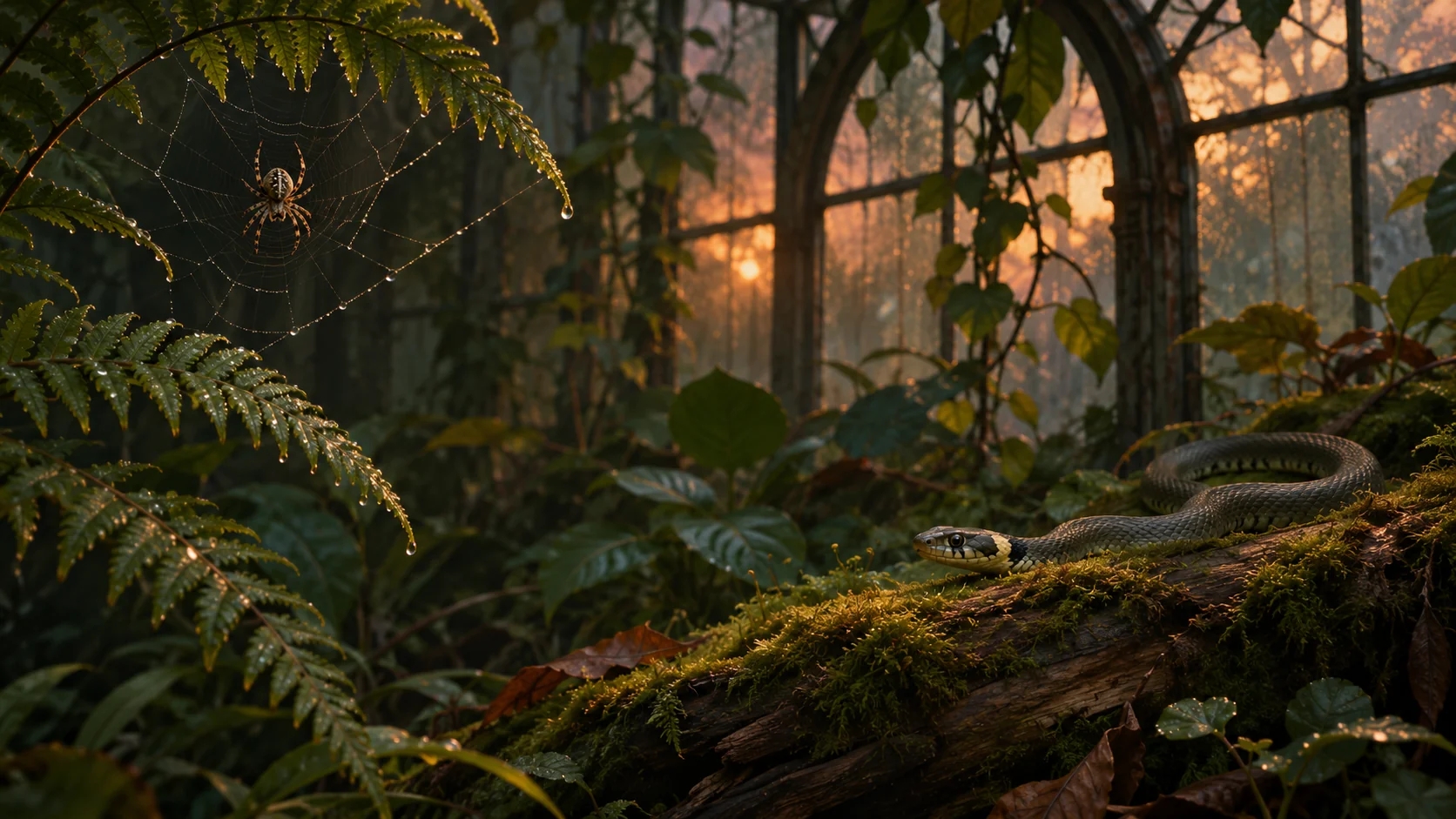
An almost invisible thread hangs by the window. You only notice it when something moves on it. Your eyes stop there. Your foot is already on its way back.
In our fictional story, Lea visits an old greenhouse. Her friend is working at a potting bench among the ferns. “There,” Lea says, pointing to the spider on the frame. Her friend glances over. “Yes. It lives here.” For Lea, that is not quite a complete all-clear.
A few steps farther on, a snake lies on a branch behind glass. Lea leans toward the sign with interest. Now her friend hangs back. A moment ago, she was smiling at the cautious distance from the spider. Now she checks very carefully whether the glass really goes all the way to the top.
A quick glance is not yet a fully formed feeling.
“It's innate” would be a convenient explanation for both responses. But what exactly would be innate: noticing a shape, physiological arousal, or already the fear of the animal? These questions are not interchangeable.
The idea of preparedness describes a possible readiness to learn certain danger associations more readily. It does not mean everyone is born with a fully formed fear of spiders or snakes. Experiences and stories can give this attention a personal meaning. Background [11]
What babies' pupils reveal.
In 2017, Hoehl and colleagues showed six-month-old infants pictures of animals and plants. Pupils were larger for spiders than for flowers. The comparison between snakes and fish differed with the experimental design: a difference appeared when separate groups of babies were compared, but not in comparisons within the same children. Study [11]
Pupil size can indicate arousal and attention. It does not directly reveal whether a baby feels fear. Later fear learning was not tested; image characteristics limit interpretation. An innate phobia is therefore not established.
Who is reassuring whom now.
Lea reads the sign aloud. Her friend nods, but stays a step farther back. On the way out, though, she takes the side beside the spiderweb. A small, wordless division of labor.
“We could swap,” Lea says. “What?”—“Our animals.” They both laugh. The spider repairs its thread. The snake stays on its branch. A lot has just happened in this greenhouse without the animals having to do very much.
Sources: Hoehl et al. (2017) [11]. Reviewed by the editors on November 6, 2026; not independently reviewed by subject-matter experts.