
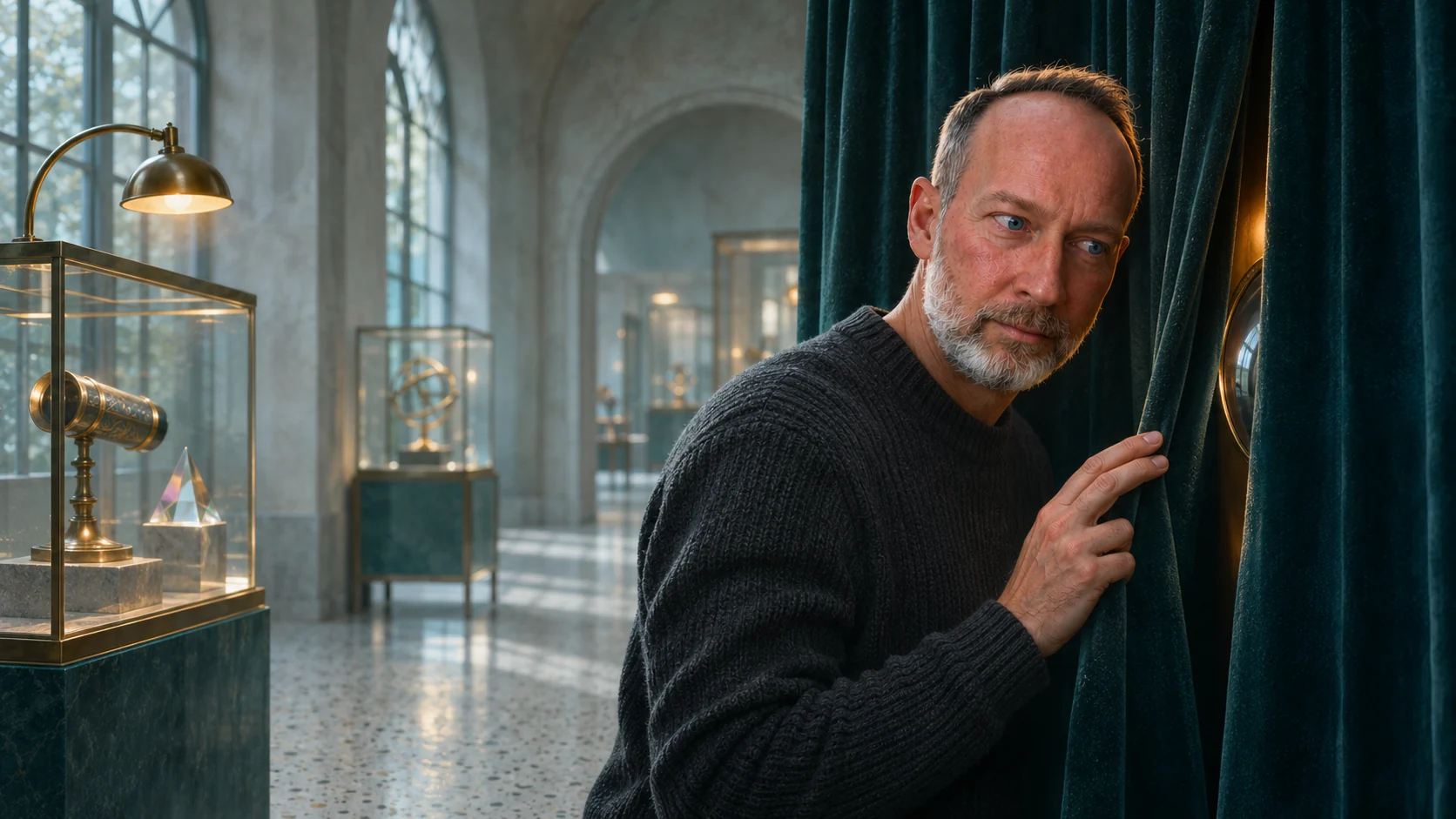
Mario passed the open display cases fairly quickly. In front of the closed curtain, he stops.
The museum displays optical illusions. Prisms, old lenses, pictures that suddenly show something else from a different angle. Daylight falls through the high windows. Nothing about this room really calls for special caution.
The heavy teal fabric, however, is making an effort. Beneath it lies a narrow strip of light. The small sign beside it says visitors may open the curtain. Nothing more. Mario reads it again, as if a technical description might appear between the lines.
A museum employee walks past. “Would you like to know what's behind it?” Mario answers too quickly. “No, no. I'm just looking.” She nods. After all, that is a perfectly normal thing to do in a museum.
With two fingers, he pushes the fabric aside. His upper body keeps a cautious distance. Something curved gleams behind the gap. A lens? A mask? An eye? Suddenly, he knows exactly which question interests him.
This scene is fictional. Mario appears as a character; it does not describe a reported experience of the author.
The question begins at the gap
The idea of an information gap offers one possible explanation: in George Loewenstein's theory, curiosity arises when we notice a gap between what we know and the understanding we want. This is an explanatory approach, not a law for every unknown thing. Read the theory [36]
In front of this curtain, the idea lends itself to a story. Mario has seen a hint, but not a whole. The curved shape supplies just enough material for guesses. A completely unnoticed object would not have posed such a question for him.
His caution has not disappeared. He wants another look while keeping his distance. In our scene, curiosity and unease can stand side by side. From the outside, we cannot tell which feeling prompted the small step forward.
What an answer can be worth to us
In 2009, Kang and colleagues examined, among other things, whether people would spend limited experimental tokens or waiting time on answers to trivia questions. Thirty students took part in this part of the study. Higher reported curiosity was associated with a greater willingness to spend these resources. Read the original study [37]
These were factual questions, not frightening museum exhibits. The finding supports the idea that an answer can have value in itself. It shows neither that concealment always sparks curiosity nor that curiosity cancels fear. Our curtain scene is a narrative application.
A familiar suspect
Mario pulls the fabric a little farther aside. Behind the curtain is a curved mirror. The man in it has a very determined gaze and an unexpectedly narrow shoulder.
He steps to the side. So does the other man. At least the question of identity seems settled.
The employee returns. “Well?” Mario leaves the curtain open a moment longer. “I know him. But I've never seen him like this.”
Sources: Information-gap theory [36] · Curiosity and answers [37]. Reviewed by the editors on November 7, 2026; not independently reviewed by subject-matter experts.