
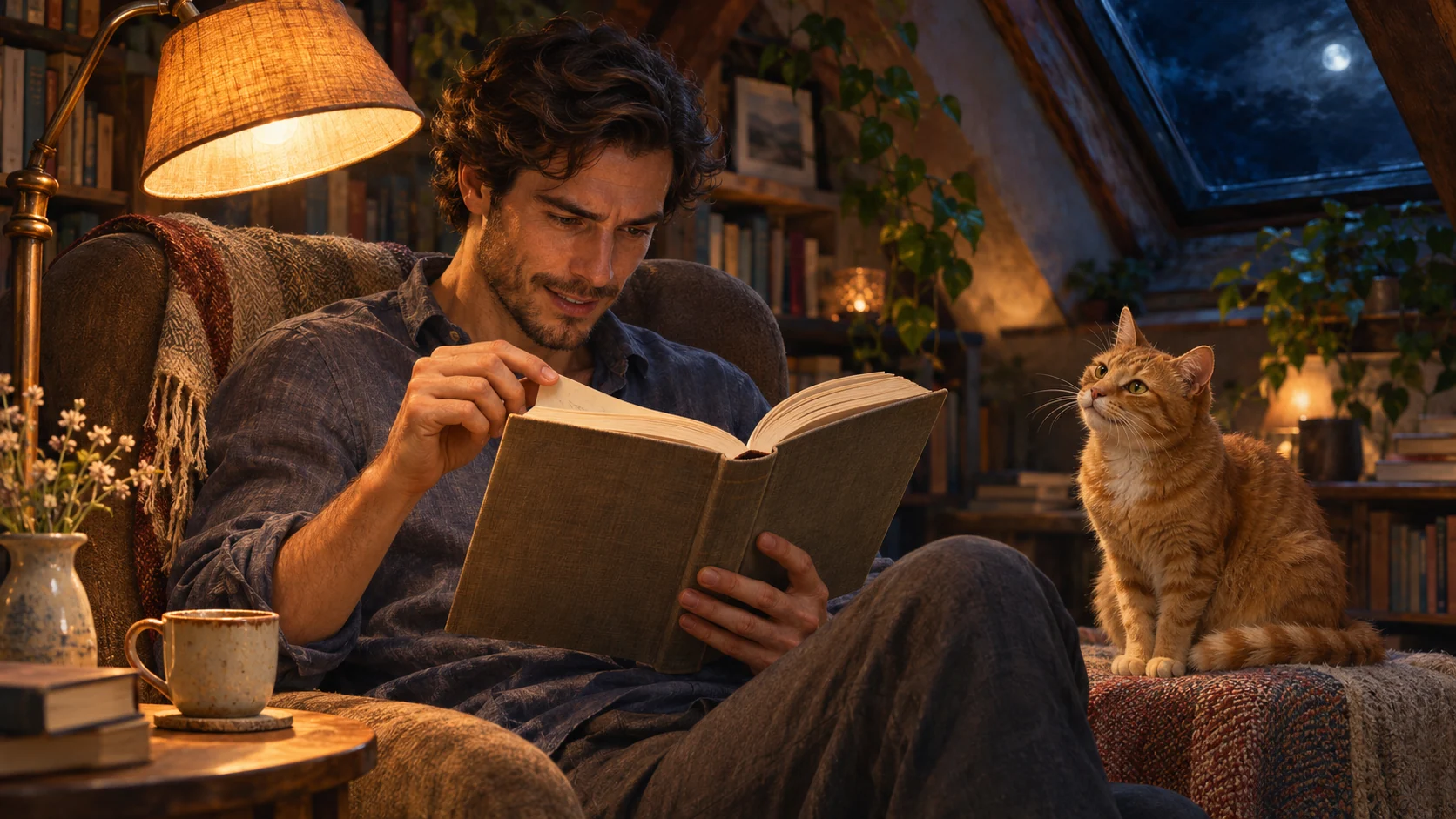
Tom has been on his way to bed for a whole chapter.
The lamp lights the novel on his knees. Night fills the skylight. Beside the armchair, the cat waits with the patience of an animal that considers its patience a considerable advance payment.
In the book, a woman has just discovered that the locked door in the house opposite was opened from the inside. By now, Tom knows the house better than some apartments he has actually visited. He wants to call out that she should not go over alone. On the next page, she does it anyway.
He looks up. His room is quiet, the tea cold, the cat very real. He could open the last chapter now. The spine would offer no resistance. He could also put in his bookmark.
Instead, he turns exactly one page.
This scene, its characters, and the novel described are entirely fictional.
He wants to read the journey too
Tom has two wishes that do not contradict each other for him right now: to find out how it ends, and to experience how the story gets there. A name on the last page might answer his question. But it would skip the journey through the house.
His curiosity is directed toward the resolution. The suspense of the scene also rests, for him, on the character he is worried about. We are describing two aspects of his reading experience, not drawing a sharp boundary between every possible feeling.
And the fiction has a book cover. Tom knows where the narrated scene takes place. Still, he briefly holds his breath as he reads. The cat apparently has no part in this agreement.
Being curious can also mean waiting longer
In 2023, Hsiung and colleagues studied slowly emerging line drawings in two online studies with a total of 2,043 participants included in the analyses. Participants were asked to guess the object. Even when they could skip to the completed picture, greater curiosity was more often associated with choosing to keep watching. Read the original study [39]
This fits the idea that discovery itself can be appealing. However, the study examined neither novels nor fear about a narrated outcome. It does not prove that spoilers invariably make stories worse. Tom's evening of reading is our adaptation, not a reenacted experiment.
Someone puts in a bookmark
The woman in the novel reaches the hallway. Somewhere in the house, something falls to the floor. Tom leans forward a little.
Then a warm paw settles across the paragraph.
He looks at the cat. It looks back. There is considerably less uncertainty about its intentions than about those of the house opposite. Tom leaves the book open on the armchair and gets up. The next page will not run away.
Sources: Curiosity during discovery [39]. Reviewed by the editors on November 7, 2026; not independently reviewed by subject-matter experts.