
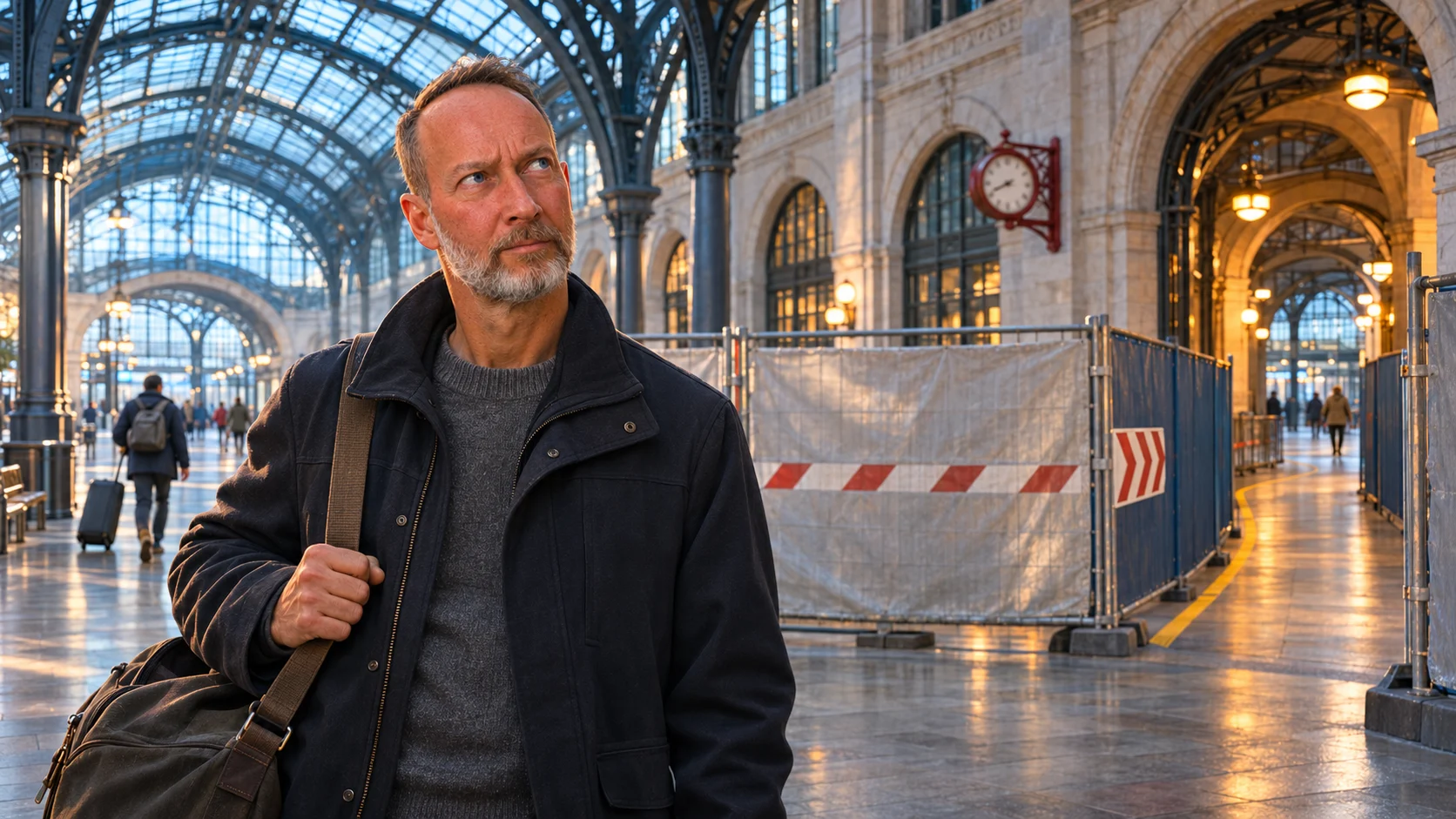
Surely Mario has just walked past this clock.
Red frame, white dial. Below it, the passage that should have taken him to the forecourt. A construction fence stands in front of it. Mario looks at the arrow on the barrier, then back in the direction he came from. The travel bag tugs at his shoulder.
He has been here often enough. Down the stairs from the train, through the hall, right past the bakery. A route that has never required a thought before. Today, something once taken for granted seems to be missing between bakery and exit.
He follows the detour. More signs hang beyond the next archway. Long-distance trains. Tram. Luggage. East exit. He wants to go west. Perhaps he should have told the station earlier.
When he sees another red clock, he stops. The same one? Or are there several in this hall? The other people walk past him so purposefully, as though they had received extra instructions.
A warm pressure rises in his throat. He has no connecting train to catch. Nobody is waiting with a stopwatch. Still, right now he urgently wants to know where he is. His gaze jumps between the archways. The faster he compares them, the more alike they look.
Beside the construction fence, someone zips up a work jacket. Mario walks over. “Excuse me. The western forecourt?” He points roughly toward the place where his original plan still stands.
This scene is fictional. Mario appears as a character; the station situation is not a reported experience of the author.
A familiar route is not yet an overview
Wayfinding means choosing a route to a destination and checking along the way whether it still fits. In the story, Mario's usual sequence no longer works. He recognizes the hall but cannot confidently identify the next passage.
The red clock could be a landmark. If similar clocks occur more than once, however, the question remains: which one am I looking at? His expectation “This is the way out” meets the construction fence. A small detour becomes a moment of uncertainty.
The building plays a part, too
Michael J. O'Neill [46] studied wayfinding in university buildings with floor plans of differing complexity and different signage. More complex layouts made finding the way harder. Signs helped, but did not completely offset the differences between simple and complex buildings.
The study examined routes, speed, and errors, not Mario's feelings in the station. It nevertheless reveals a relevant point: someone who takes a wrong turn has not necessarily just failed to pay attention. The environment can also be difficult to read.
The clock gains a second meaning
“Through the archway, then left. You'll come out behind the construction work,” says the woman in the work jacket.
Mario looks at the clock. “And there are several of those here?”
She nods. “The time ought to be right everywhere.”
That is hard to argue with. Mario thanks her and goes through the archway. A little later, he sees daylight, the forecourt, and the bakery from the other side.
The station has not become smaller. But the next step has a direction again.
Sources: Floor plan and signage [46]. Reviewed by the editors on November 7, 2026; not independently reviewed by subject-matter experts.