
The lighthouse is gone.
Leander saw it just a moment ago, small and white at the far end of the bay. Then fog drifted from the water across the beach. First the tower faded. Now Leander cannot even say for certain where to look.
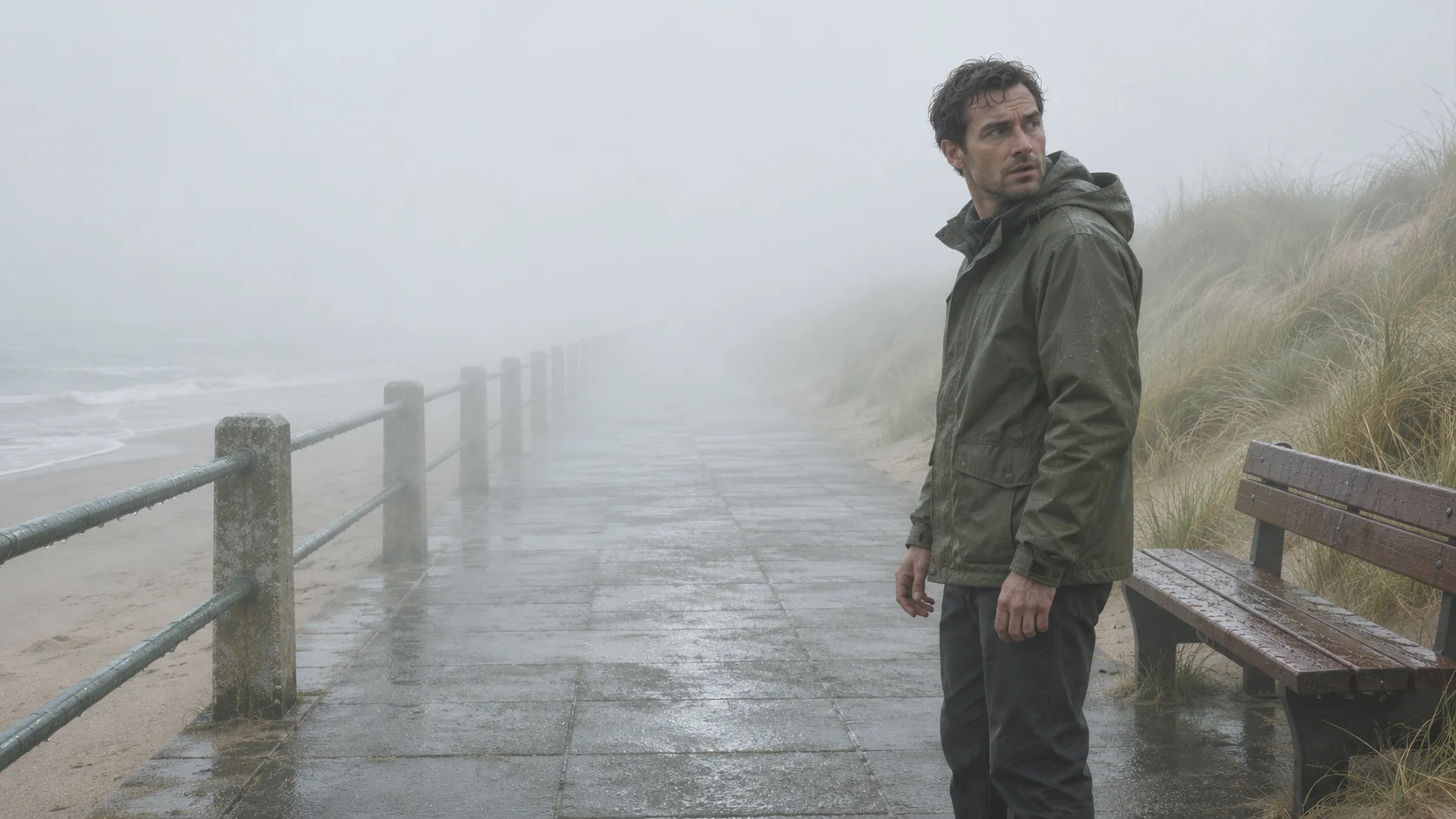
He stands on the promenade beside a bench. Dune grass grows to the right; to the left, the railing runs along the beach. Wet paving stones lie beneath his shoes. There is no doubt that this is a path.
Only a moment ago, though, this path stretched as far as the café. At least to the eye. Now it ends after a few railing posts in pale gray.
Leander turns around. He knows the bench. Or does he mainly know this kind of bench? Dark wood, metal legs, a patch of chipped paint. Earlier, he passed several without paying them much attention.
He had intended to turn back once he saw the lighthouse in line with the café. A remarkably precise plan for two things that are both absent right now.
The waves are still audible. A few footsteps click somewhere on the paving. Leander pulls his collar higher and notices how alert he has become. It is not the path beneath him that worries him. It is whether he is still judging correctly how far he has come.
This scene and its characters are entirely fictional.
A path and its direction are not the same thing
Spatial orientation means locating ourselves and establishing our orientation in relation to the surroundings. Leander has nearby cues: paving, bench, and railing. Distant landmarks that showed him the larger picture are no longer visible.
In the story, uncertainty arises even though the place has not moved away. What is missing is part of the information. The fog provides no new threat for the narrative; it takes away the range of view Leander had relied on.
Straight ahead does not always feel straight
Jan L. Souman and his research team [48] recorded the routes of people asked to walk straight in forests and deserts. Without visible sun, participants repeatedly walked in circles; with visible sun, they still deviated but did not form circles. Further blindfolded experiments argued against a fixed leftward or rightward bias as a general explanation.
The authors interpreted the deviations as accumulating error without external cues to correct their direction. This is not an experiment on a foggy promenade: Leander still has a built path and a railing. The finding shows why our own sense of straight ahead alone may not be a reliable compass—not that everyone inevitably walks in circles in fog.
Someone knows this bench
The footsteps belong to an older couple. As they come closer, Leander asks about the café.
“We've just come from there,” the woman says, pointing back along the railing. “We're going back too. My husband left his umbrella.”
The man looks into the pale gray. “Luckily, not the lighthouse.”
They laugh briefly. Leander walks back with them. The fog stays, and the tower does not return at once. But the bench behind him is now the bench where they met.
Sources: External cues and walking direction [48]. Reviewed by the editors on November 7, 2026; not independently reviewed by subject-matter experts.