
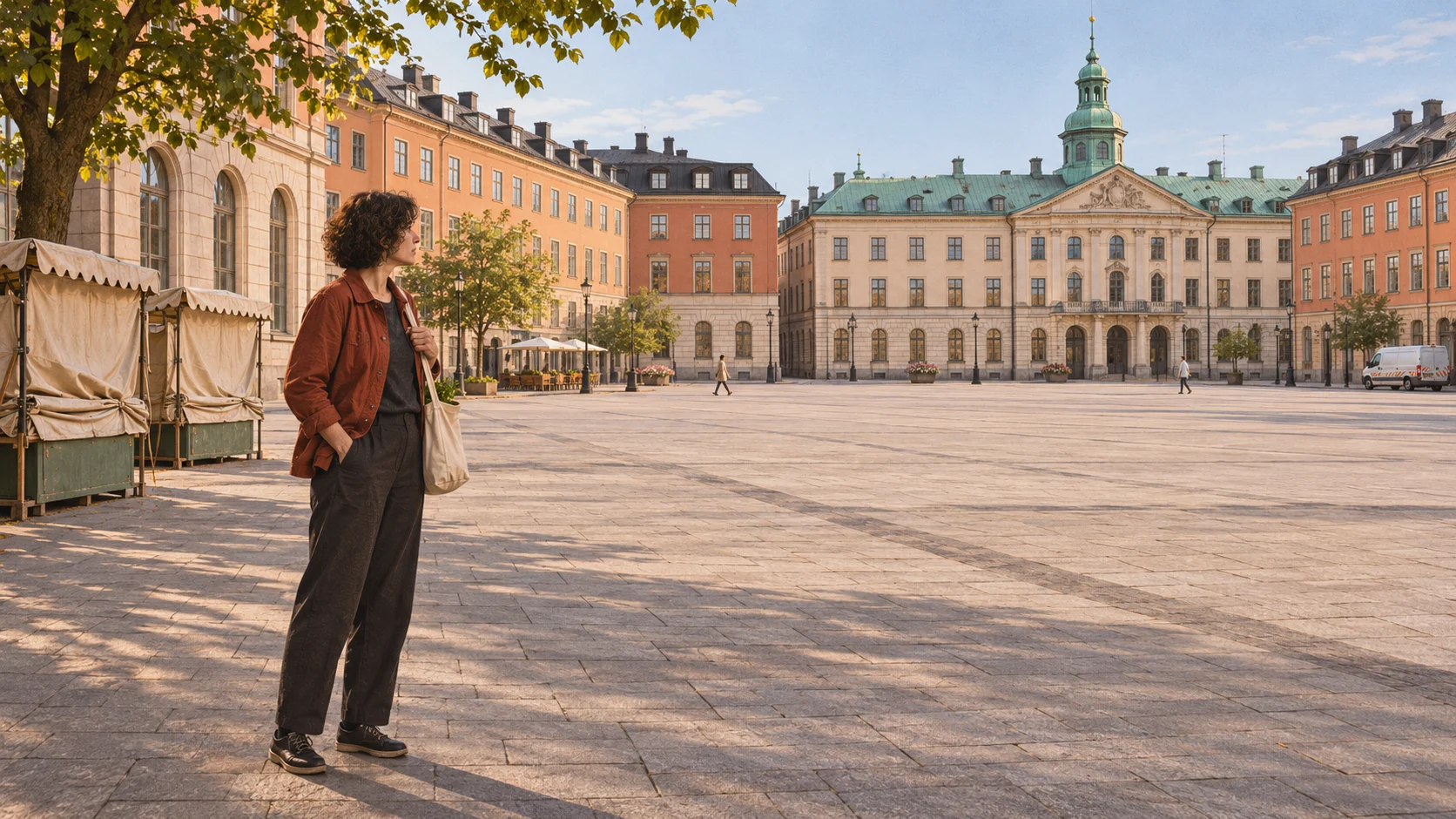
Selma stops beneath the tree. There was not this much space here this morning.
Of course there was. Beneath the stalls, the crates, and the people with their shopping bags. But then it had consisted of little lanes: past the cheese, right behind the flowers, out again by the red umbrella.
Now most of the stalls have been dismantled. A delivery van waits at the side. Two closed booths look as though they failed to say goodbye in time. Between them, bright paving spreads all the way to the houses on the far side.
After the market, Selma visited an acquaintance. Now she wants to get back to the stop. The passage is opposite, somewhere among the facades. She knows that. Only “opposite” is remarkably large right now.
She shifts the bag from one shoulder to the other. A bicycle bell rings from the edge of the square. Her own first step sounds louder than expected. She walks a few meters and slows down again.
Nothing has happened. Nobody is following her. The sky is bright. Still, the stretch to the houses feels exposed. Selma searches for the red umbrella with her eyes, although she has just watched the florist's van drive away.
Then she spots the green tower roof. It was visible above the stalls this morning. To its left, she remembers, must be the narrow lane.
This scene and its characters are entirely fictional.
Not everything conspicuous stays in the same place
A landmark is a recognizable reference point for orientation. Selma's red umbrella was conspicuous but temporary. The tower roof is a permanent part of the surroundings. That difference matters a great deal for her way back right now.
The changed context removes some cues from her familiar route. She can see a long way and still needs to work out her position again. The feeling of standing on a stage belongs to Selma's fictional experience. An empty square might mean openness, calm, or freedom to someone else.
Recognizing and locating are different tasks
Stephen D. Auger, Peter Zeidman, and Eleanor A. Maguire [47] had 32 people learn a virtual environment with permanent and changing landmarks. Those who later navigated less well had distinguished less reliably between permanent and changing objects while learning. Merely recognizing the objects, by contrast, did not distinguish the groups in the same way.
The investigation concerns learning a virtual environment, not fear in public squares. It fits a limited question in the story: do I merely recognize something—or do I also know whether it works as a fixed reference point? Selma's discomfort cannot be inferred from it.
The tower does not have to come along
Halfway across, Selma turns around once more. Someone with a dog has now stopped beneath the tree. From here, the place where she hesitated a moment ago looks quite ordinary.
Before entering the narrow lane, she pauses at a shop window. The tower roof is reflected in it. Now she knows where the stop is again.
At the next market, the red umbrella will probably be back. For today, she is content with something that does not get folded away in the evening.
Sources: Permanence of landmarks [47]. Reviewed by the editors on November 7, 2026; not independently reviewed by subject-matter experts.