
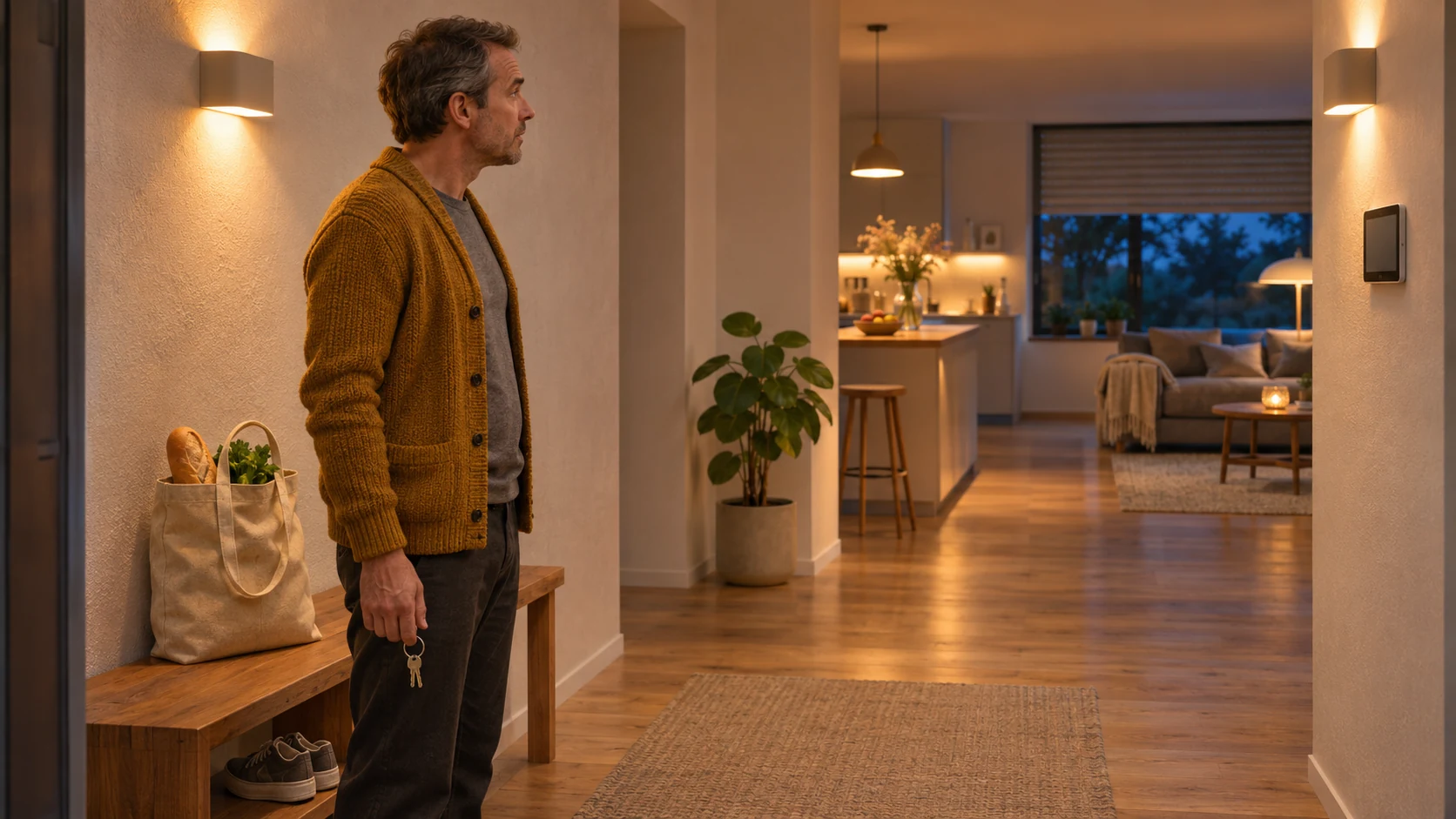
Henrik still has the key in his hand when the hallway light comes on.
That is useful. He puts down the shopping bag, steps over the threshold, and is about to close the door. Then the kitchen lights up, too. Next, the living-room blind lowers with a quiet hum of its motor.
He stops. Outside, the sky is dark blue. Inside, everything looks as it did this morning, only a little more determined. “Well, you're in a hurry,” he says into the empty hallway.
The lamps do not answer. Apparently, they have already made their contribution.
Henrik remembers an evening at the kitchen table, several settings, and the satisfying thought of having fewer switches to press in the future. Only the exact sequence has slipped his mind. One lamp would not have surprised him. The little coordinated performance briefly feels like a welcome he was not prepared for.
He picks up the bag again. Carefully, as if that might trigger another decision by the house.
This scene, its characters, and the described home automation are entirely fictional.
“It happens” becomes “It wants to”
Henrik knows the difference between a setting and an intention. Still, he speaks to the house as though someone has been too hasty. With that single sentence, the technology has almost acquired a personality.
Anthropomorphism means attributing human qualities or inner states to nonhuman things. Such an interpretation can be meant seriously, but can also arise playfully. Henrik's remark alone does not tell us how literally he takes it.
In our scene, he initially lacks some understanding of his own influence. He has set something up but does not immediately recognize the sequence. For a moment, his home seems like another being facing him. It needs neither a face nor a voice for this.
Intentions as an attempt to understand something
Waytz and colleagues reported in 2010 that anthropomorphism increased in several experiments when nonhuman agents seemed less predictable or when the incentive to understand and control them grew. A further investigation suggested that anthropomorphism can make something seem more understandable and predictable. Original abstract [42]
These are findings about the attribution of human qualities, not evidence of consciousness in devices. Nor did the studies examine Henrik's unease or the effects of today's home automation. The connection supplies a question for our story, not a complete explanation of his evening.
An earlier version of Henrik
He finds the entry on the control panel. An arrival rule linked to dusk. The blind belongs to a separate schedule. Two sequences that happen to fall close together today.
He reads his own label: “Cozy evening.” Apparently, an earlier version of Henrik had very definite ideas about when that should begin.
From the bag, he takes out bread, cheese, and a package of pasta. The house has thought of many things. It has not yet thought of putting the groceries away.
“I'll do the rest,” he says. This time, he is glad nobody disagrees.
Sources: Anthropomorphism and predictability [42]. Reviewed by the editors on November 7, 2026; not independently reviewed by subject-matter experts.