
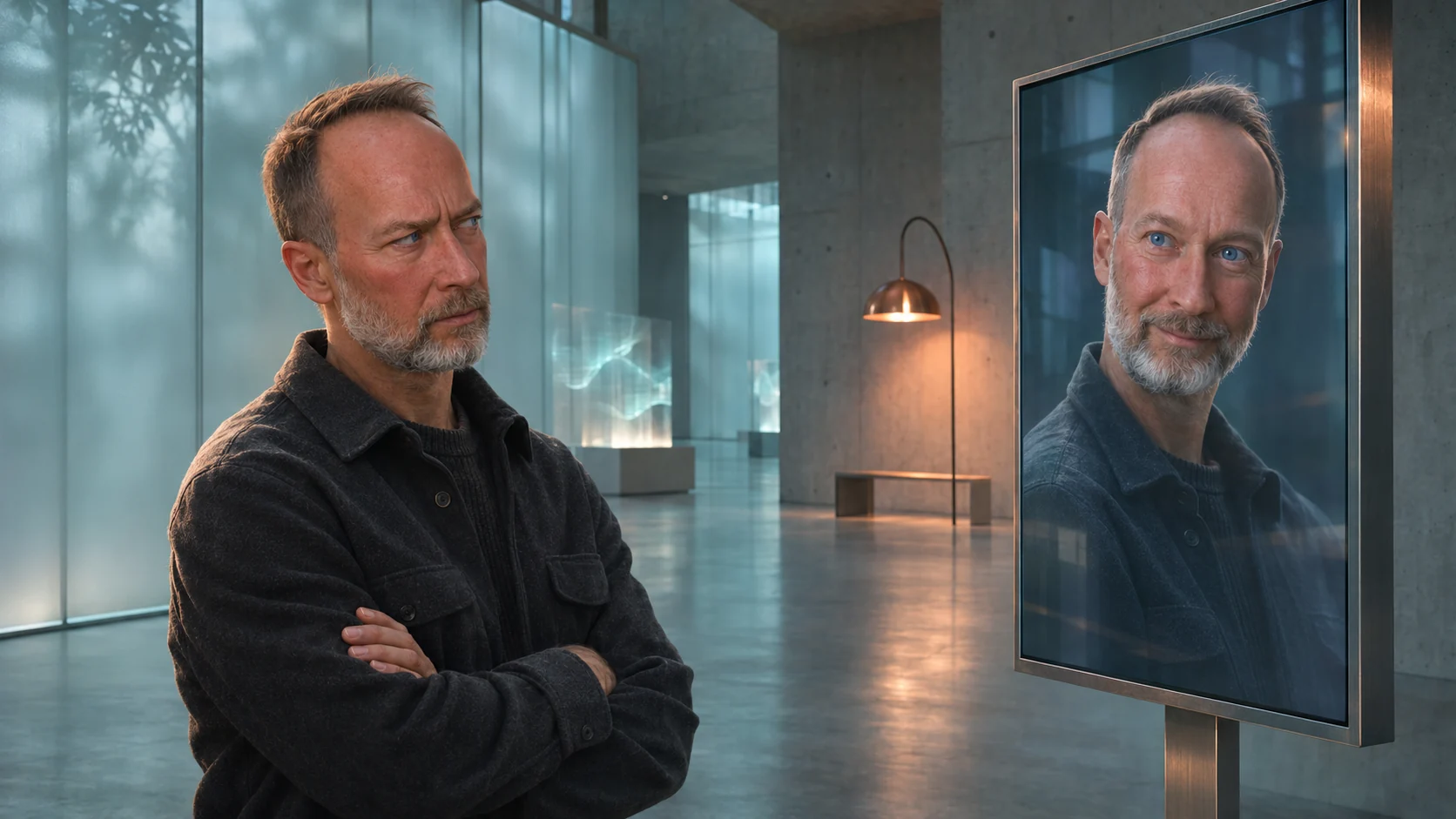
Mario recognizes the man immediately. That is reassuring. It is his own face, after all.
The small media gallery has created a digital double from a portrait he authorized for use. Between glass walls and pale concrete stands a screen in portrait orientation. The man on it has his beard, his blue eyes, and looks at him as though the meeting had been arranged long ago.
Mario steps closer. The resemblance is astonishing. Even the little crease beside his mouth is there. Then he notices what bothers him: the other man is still smiling. Not broadly. Not maliciously. Just with an endurance Mario recognizes in himself only to a limited extent.
He raises an eyebrow. The screen holds its friendly ground. It is not a mirror; he knew that beforehand. Still, for a moment he expected a response.
Beside him, a staff member explains that the animation runs in a loop. Mario nods. That explains the sequence. It does not quite explain why he has just taken half a step back.
This scene is fictional. Mario appears as a character; the gallery and the encounter do not describe a reported experience of the author.
A familiar face, an unfamiliar expression
In this scene, the familiar stands particularly close to the strange. Mario does not first have to work out who is being portrayed. That is precisely why the small discrepancy stands out. By now, he is looking at the screen less like a successful portrait and more like a conversation partner who has missed his cue.
The uncanny valley is a research question concerning discomfort with almost human replicas. It does not supply an automatic rule by which every realistic figure must eventually become eerie. Our other Mario is a narrative approach to the subject.
In The Puppet in the Window, the apparent gaze stays behind glass. Here, the figure facing Mario has his own face. Both stories play with an expectation that the image itself cannot fulfill.
When visual features do not fit together
In 2016, Chattopadhyay and MacDorman studied images whose features were rendered at different levels of realism. In experiments with 365 students, such inconsistency could increase eeriness in human and animal depictions. This effect did not appear for the objects examined. Original study [40]
The study examined static images, not one's own double with a fixed smile. It therefore does not directly explain Mario's response. It shows one possible influence of design; our scene adds personal expectations and a movement loop.
The other one still has time
The staff member stops the animation. For a moment, the face seems calmer to Mario. Now it is an image visibly keeping still.
“Should he smile less?” she asks.
Mario looks at himself once more. “Maybe now and then. Otherwise people will think I never have anything to complain about.”
She starts the loop again. The other man takes it remarkably calmly.
Sources: Inconsistent realism [40]. Reviewed by the editors on November 7, 2026; not independently reviewed by subject-matter experts.