
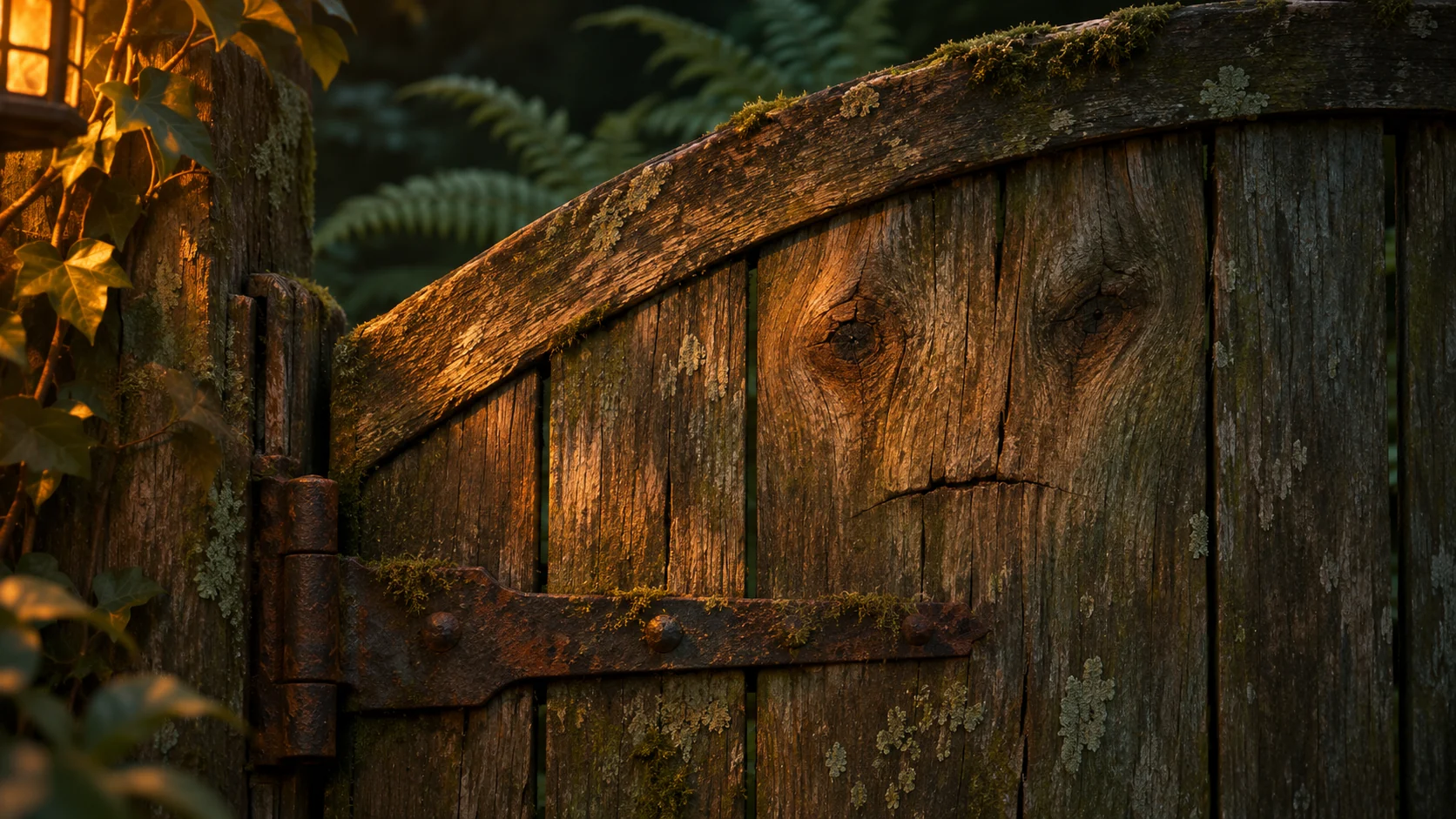
You only mean to close the garden gate. Then you notice the two dark spots in the wood. For a moment, it looks as if someone is waiting there for you.
In our fictional scene, a lantern hangs beside the door. Its light falls across the old gate at an angle. Two knots sit at roughly the same height. Below them runs a crack. You stop. The gate has neither blinked nor moved. Yet you have just given it a gaze.
As you step closer, you recognize the rings around the knots, the flaking wood, and a rusty nail. It all belongs to a perfectly ordinary board. And yet: as soon as you take a step back, the face is visible again.
An object can look like a face.
Pareidolia means recognizing meaningful shapes in ambiguous patterns. Apparent faces in inanimate objects are a particular case. Knowledge and visual impression need not exclude each other: you can recognize the board and see a face in it at the same time. Background [9]
In our scene, there is also a narrative choice. We could have written, “Two knots lie in the light.” Instead, we spoke of a gaze. That is an invitation to your imagination. The context changes the story we build around the image.
How researchers study such images.
In 2020, Wardle and colleagues compared images of human faces, face-like objects, and similar objects without the impression of a face. Using functional magnetic resonance imaging and magnetoencephalography, they examined spatial and temporal patterns of brain activity. The initially face-like processing of illusory faces quickly shifted toward a more object-like representation. Study and explanation by the first author [9]
This is a study of visual processing. It shows neither that such images must cause fear nor that a particular knot has a measurable effect on you. Our image was specially composed and was not test material in this study.
The gate gets a name.
You close the latch. “Good night, Mr. Garden Gate.” Now the crooked crack looks almost a little grumpy. The wood has not changed. Only your little story has acquired a different tone.
Perhaps that is the appealing moment: we can recognize a shape, understand how it came about, and still play with the impression. Whether that produces a shiver, a smile, or nothing at all, we leave open.
Source: Wardle et al. (2020) and explanation by Susan G. Wardle [9]. Reviewed by the editors on November 6, 2026; not independently reviewed by subject-matter experts.