
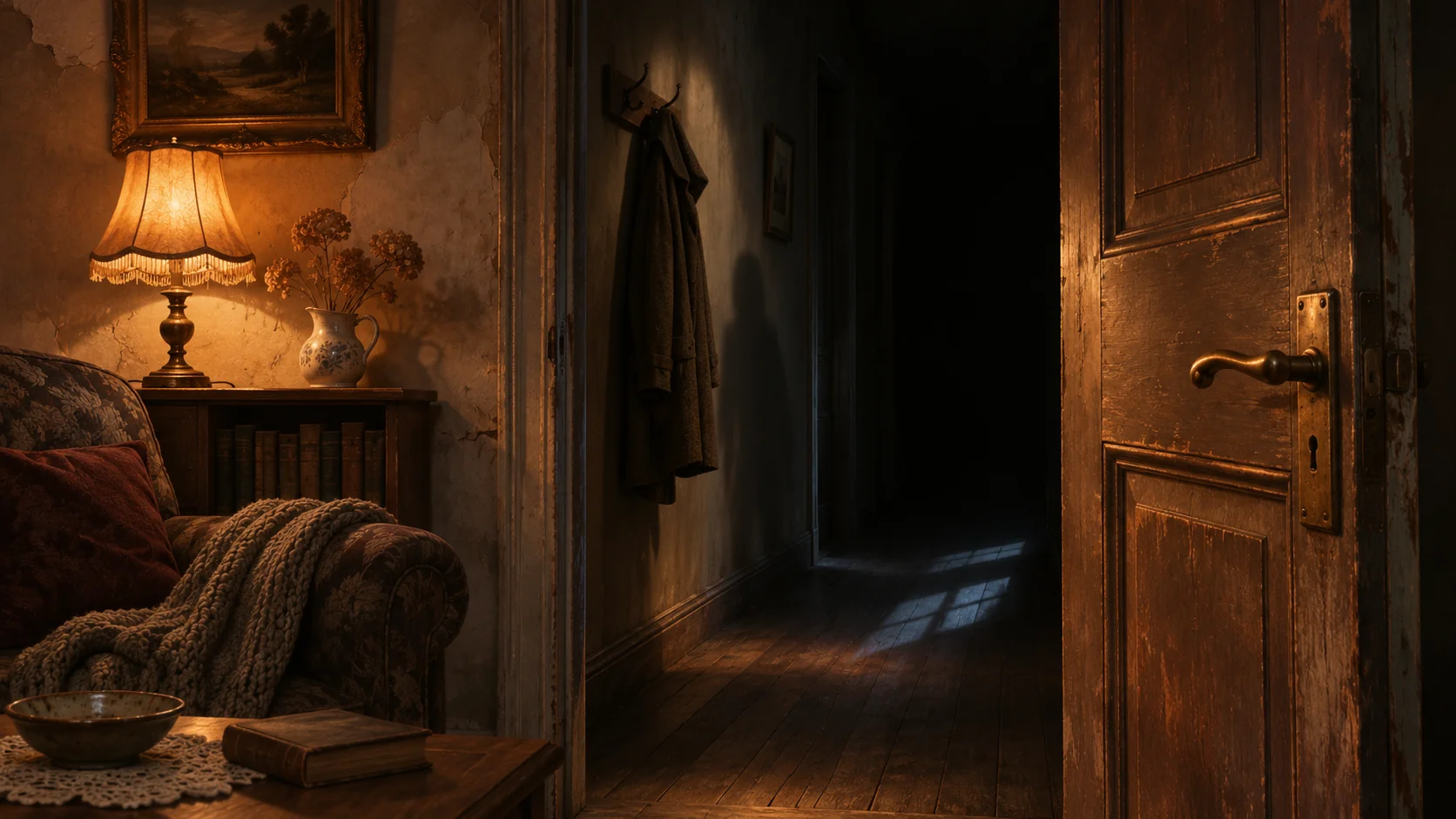
The camera stays in the living room. A door opens in the hallway. All we see is its edge. Someone in the film holds their breath, and suddenly even the space beyond the frame seems occupied.
In this fictional film scene, a cup stands on a table. A coat hangs by the door. Everything looks lived in; only the residents are missing. A dragging sound comes from the next room. Perhaps a chair is being moved. Perhaps something else entirely.
The camera could go and look now. It does not. Instead, it shows the door handle, a fold in the coat, the dark gap. We start inspecting the few visible things as though they might provide information. The cup is very convincingly silent.
Then the sound stops. The door does not move at all. For a moment, less is happening in the frame than before. Still, suddenly we want to know whether someone is behind us.
The edge of the frame tells a story too.
The framing makes part of the invented world visible and leaves another part open. A sound can point to a room outside the image. The scene need not immediately answer whether anything threatening is actually waiting there. In our example, the unsettling possibility emerges from the interplay of door, sound, and waiting.
Here, suspense is a useful term: tension directed toward what is coming. A jump scare can interrupt or release it, but is not necessary. The hallway may stay silent. And context matters too: the same shot in a comedy might announce a late guest's arrival.
This does not mean the unseen is always scarier. Our scene illustrates a creative possibility. Someone who has already identified the coat as a coat, or finds the characters uninteresting, may simply be waiting for the plot to move on.
Suspense needs a future that matters to us.
In a psychological model, Lehne and Koelsch describe how conflicts, uncertainty, and anticipated meaningful events can create suspense. It is not only a question of what happens, but also when and how it happens. Model [20]
This is a theoretical framework, not an experiment with this exact door scene. The authors also discuss why stories can remain suspenseful on repeat viewing. A known ending does not simply rule out suspense. How much uncertainty is necessary remains an open theoretical question.
We do not get every answer.
The camera finally moves into the hallway. Behind the door lies an overturned chair. The window is open. A curtain touches the floor. So there is a possible explanation for the dragging sound.
Then the film cuts back to the living room. Now there are two cups on the table. Perhaps we overlooked the second one before. Perhaps the scene withheld something from us. The door has passed on its question. Now it is the table's turn.
Sources: Lehne & Koelsch (2015) [20]. Reviewed by the editors on November 6, 2026; not independently reviewed by subject-matter experts.