
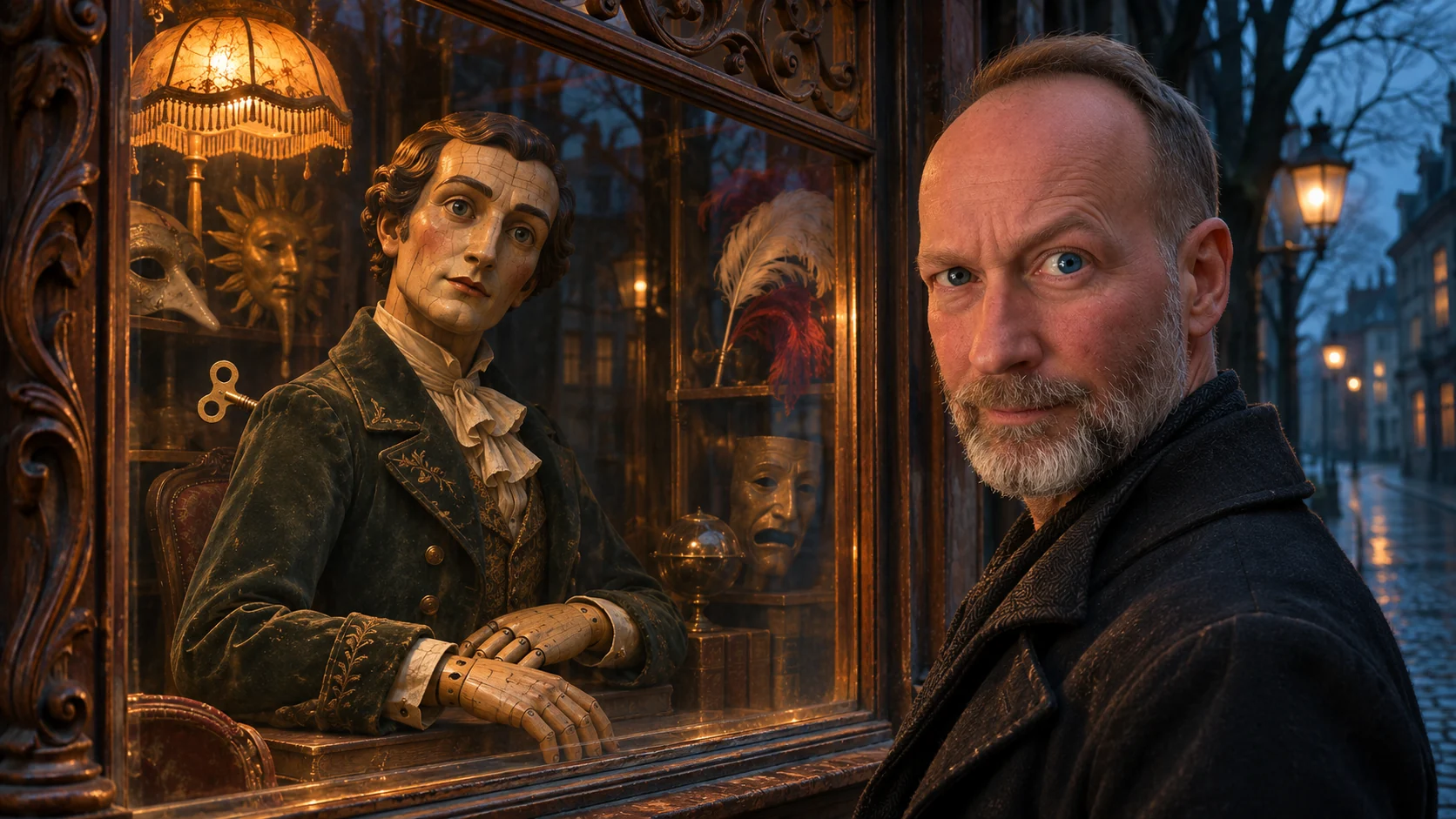
The puppet sits in the window of a prop shop. A dark coat, neatly folded hands, its head tilted slightly. As Mario is about to walk on, he looks back once more.
We invented this scene. The figure is clearly built as a theater puppet: there is a joint at its wrist, and a small key sticks out of its side. Mario therefore knows what is in front of him. Still, he waits a moment longer than he meant to. Just to make sure it does not turn its head after all.
Inside, a lamp comes on. A woman puts a cup on the sales counter. The puppet stays as it was. “She's done enough work for today,” the woman says. Mario nods as if that were an entirely adequate explanation.
When familiar shapes feel strange.
In our story, the uncanny lies in an unresolved expectation: a humanlike counterpart might respond. The puppet does not. Through its head position, lighting, and gaze, we nevertheless give it an apparent intention. This is a creative reading of this scene, not a law about how people respond to puppets.
Unlike the incidental face in a knot in wood, this figure was deliberately built. Designing a face and attributing life to it are two different things. That very gap offers room for play in fiction.
Olimpia: more than a spooky prop.
E. T. A. Hoffmann's story The Sandman presents Olimpia, an artificial figure whom Nathanael takes for a living woman. He experiences her brief answers and her listening as deep understanding. Other characters, by contrast, describe her rigid, mechanical manner. Literary primary source [10]
Our reading therefore asks more than how convincingly lifelike Olimpia looks. It also asks how much Nathanael reads into her. In an encounter, who is actually talking to whom? And when does an apparent counterpart become a surface for one's own desires?
The text then shifts the uncertainty into its characters' society: after the automaton is exposed, people suddenly look for evidence that other people are alive as well. Hoffmann turns the deception into a disturbing and sometimes comic scene of mistrust. This is literature, not a psychological experiment.
One last look is enough.
Mario walks a few steps farther. In the glass, the reflection of a streetlight now falls directly across the puppet's eye. It looks as if she is winking. “Very funny,” he mutters.
Whether the next sentence in our story offers a harmless explanation or a fantastic twist is up to the narrative. The puppet itself has so far given us no reason whatsoever to attribute intentions to it. We have simply looked very closely.
Source: E. T. A. Hoffmann: The Sandman [10]. Reviewed by the editors on November 6, 2026; not independently reviewed by subject-matter experts.