
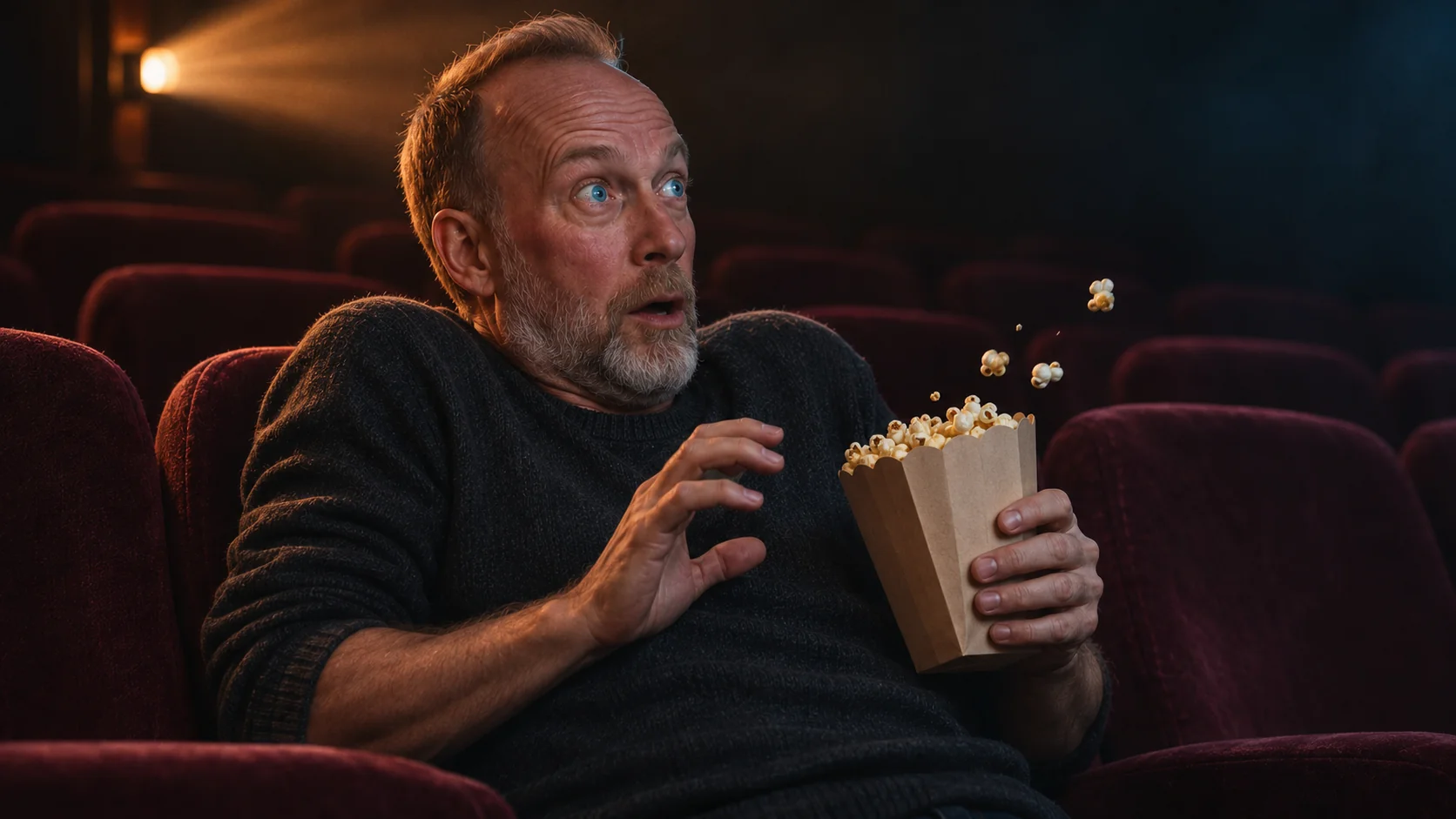
On the screen, a woman stands in front of a wardrobe. Mario knows what is about to happen. He has prepared himself. The popcorn apparently has not.
In our fictional scene, all we hear at first is footsteps. Then nothing. The woman puts her hand on the handle. Mario takes his fingers out of the bag, just in case. Very sensible, he thinks. The wardrobe door opens. Empty hangers.
He breathes out. Something moves in the background, and the sound slams into the picture like a door. Mario's shoulders shoot up. The bag rustles. For one absurdly brief moment, a few pale flakes hang in front of the dark screen, as if the film now has subtitles made of corn.
Then everything is back where it belongs. Almost everything. Mario looks down at his sweater, picks up a piece of popcorn, and decides that nobody in his row noticed a thing. Behind him, someone suppresses a laugh.
A cinematic device meets a response.
A jump scare is a cinematic device. A sudden visual event, often accompanied by a striking sound, is intended to surprise or frighten us. The startle reflex, by contrast, is a bodily response. Film technique and response are therefore different things; a startle alone does not explain a longer-lasting feeling of fear.
Acosta and Sears suggest considering what comes before and after as well: expectations, timing, and interpretation are part of the effect. Their contribution is a theoretical commentary. It provides no formula for making every viewer reliably jump. Article [18]
In our scene, Mario expects the scare to come from the wardrobe. At first, the film leaves that expectation unanswered. This is our little narrative construction: the intention is predictable, but the place and moment remain open.
The long shadow and the brief scare.
Hudson and colleagues studied 37 people watching horror films in an MRI scanner. They compared activity patterns associated with sudden scares with those associated with sustained fear. Their analysis suggests that partly different systems are involved, while also showing how they work together. Study [19]
They measured changes in blood flow in the brain as an indirect measure of neural activity. That is neither mind reading nor a measure of how good a film is. Studying the experience of films also does not allow a simple transfer to real danger. For our question, one point remains: the moment of jumping and the long anticipation before it each deserve attention of their own.
The next wardrobe will not stay empty for long.
Later, the film shows another door. This time Mario holds the bag with both hands. He is certain that he has understood the setup. On the screen, a hand slowly approaches a handle.
Nothing happens. Still nothing. Mario leans forward a little. Anyone asking him now whether he feels more or less scared would probably not get a quick answer. For now, the popcorn stays put.
Sources: Acosta & Sears (2026) [18] · Hudson et al. (2020) [19]. Reviewed by the editors on November 6, 2026; not independently reviewed by subject-matter experts.