
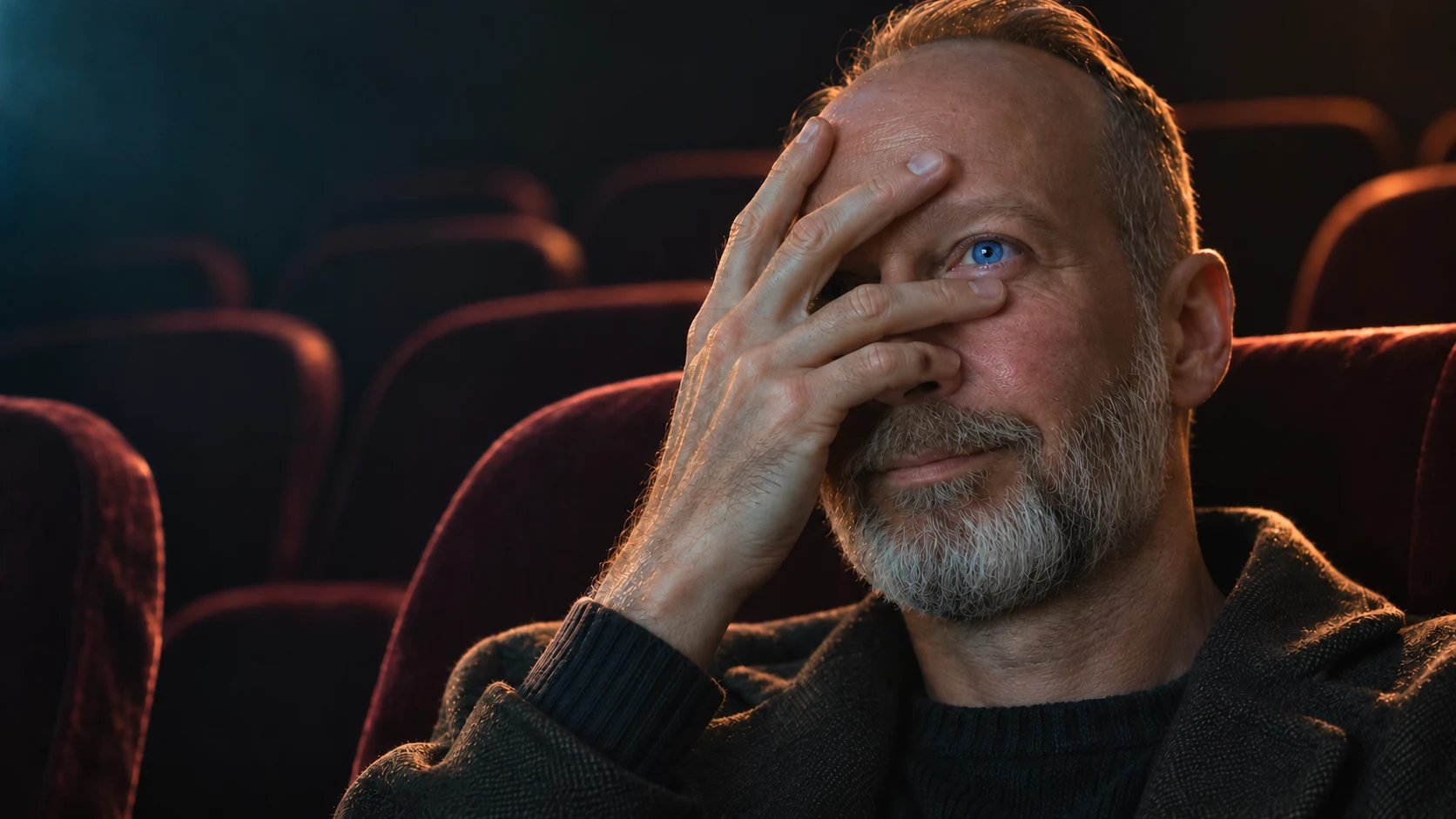
The door on the screen opens slowly. You raise your hands in front of your eyes. A gap remains between two fingers.
The scene is fictional; the question behind it is our starting point: why do we sometimes want to see less and still know what happens next? “Peeking through our fingers” is an image for this contradiction here, not a scientifically defined response.
A story we want to stay with.
Imagine two viewers in the same theater. One wants to solve the mystery. The other finds the scene unpleasant and turns away. Even the same story need not hold the same appeal for both.
As an interpretation of our opening scene, the narrow gap might represent a compromise: some distance from the image without losing the plot entirely. Whether that explanation applies to a particular person would need investigation. The gesture alone cannot reliably reveal an inner state.
Measuring fear and enjoyment together.
For our question, it is worth looking at research on recreational fear: how can fear and enjoyment be studied together? The field study by Andersen and colleagues took place at a horror attraction. Peeking through fingers was not studied there. Field study [3]
In The Fear Paradox, we explain the findings and their limits. For our cinema gesture, the question remains open: what is this person experiencing right now, and why do they want to keep watching?
How much fear is exciting?
Further questions remain for our cinema story: what roles do the characters, companions, knowledge of fiction, and ability to look away at any time play?
Perhaps the movement between approach and distance is the most intriguing part of our scene. That is a thought to explore further, not a general law of fear.
Reviewed by the editors on November 6, 2026 · Not independently reviewed by subject-matter experts. Sources & editorial approach