
On the screen is an empty corridor. A long creak comes from the speaker. The door in the image has not moved yet. Where is the sound coming from?
Our fictional story begins in a small screening room. You hear a sound whose source lies outside the frame. Perhaps the door at the end of the corridor is opening. Perhaps another door behind the camera. The shot does not reveal it.
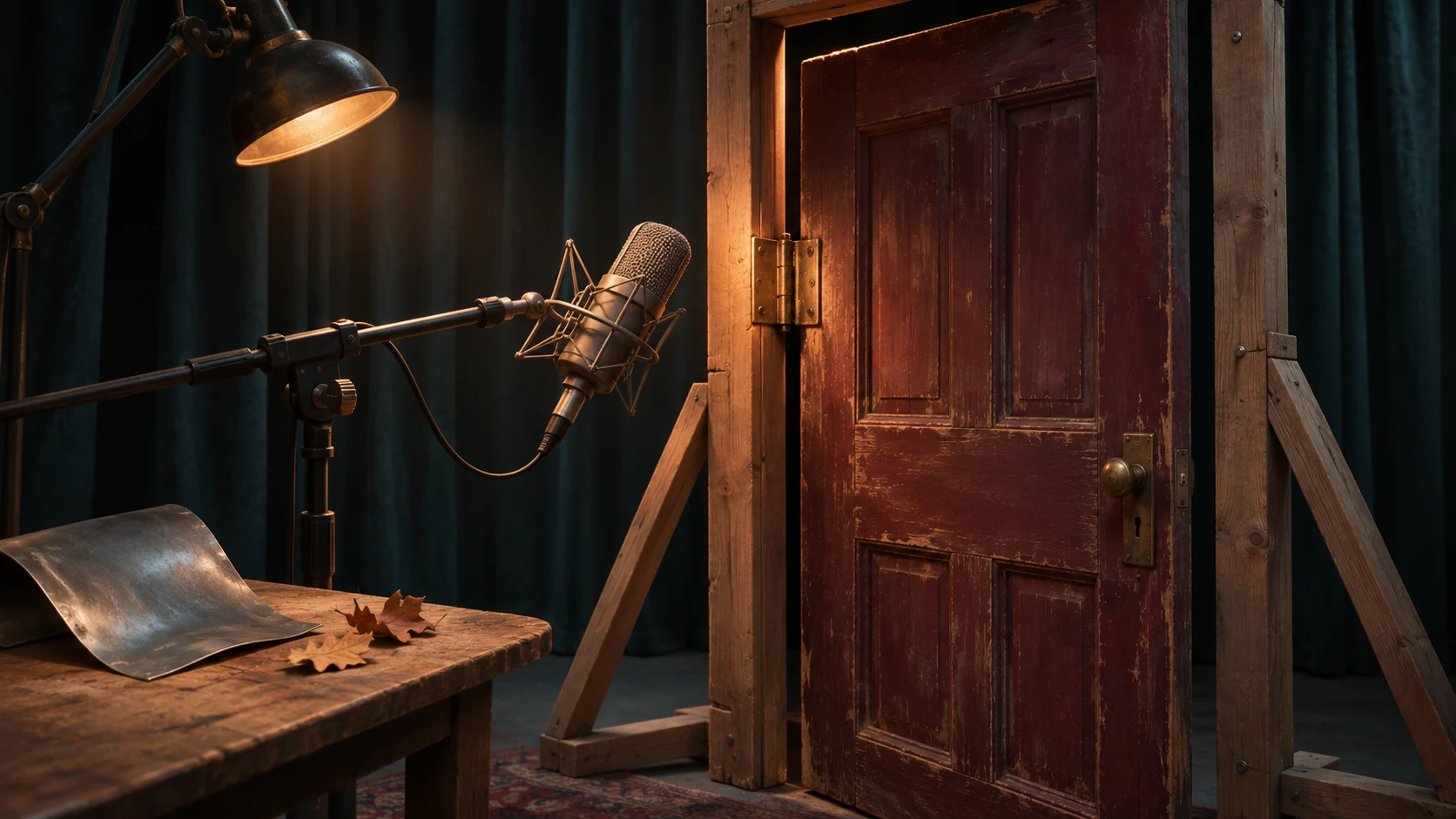
Then the image cuts to a workshop. The same kind of door stands there in an open wooden frame. A microphone points at the hinge. Someone moves the door a little. The creaking returns. This time, we see how it is made.
A sound acquires a role.
In the first shot, the creaking belongs to the unknown world behind a door. In the second, it is part of a recording. We have changed the context of our narrative. That raises a different question too: what will happen here—or how was this sound produced?
This offers a way to think about fiction through hearing as well. A film scene can give information while concealing its source. Our workshop is a designed example; the image shows no particular studio or documented film production.
Music alone—and music with images.
In 2012, Blumstein, Bryant, and Kaye studied short musical pieces to which they added features including noise and abrupt pitch changes. When heard without images, pieces with noise or an upward pitch shift were rated as more arousing than the control versions. Study [8]
Another group heard the same music alongside videos of everyday actions. Here, no corresponding significant difference in arousal ratings was found. The study examined musical examples and self-reports, not our creaking door. Arousal is also not a direct measure of fear or of the startle reflex. Methods and findings [8]
Back to the empty corridor.
The workshop disappears. You see the corridor again. You now know one possible source of the creaking. Yet you still do not know who might be standing behind the door within the film's story.
Knowing how a sound was made and understanding its meaning in a story are two different questions. Which will occupy you first in the next film?
Sources: Blumstein, Bryant & Kaye (2012) [8]. Reviewed by the editors on November 6, 2026; not independently reviewed by subject-matter experts. Sources & editorial approach