
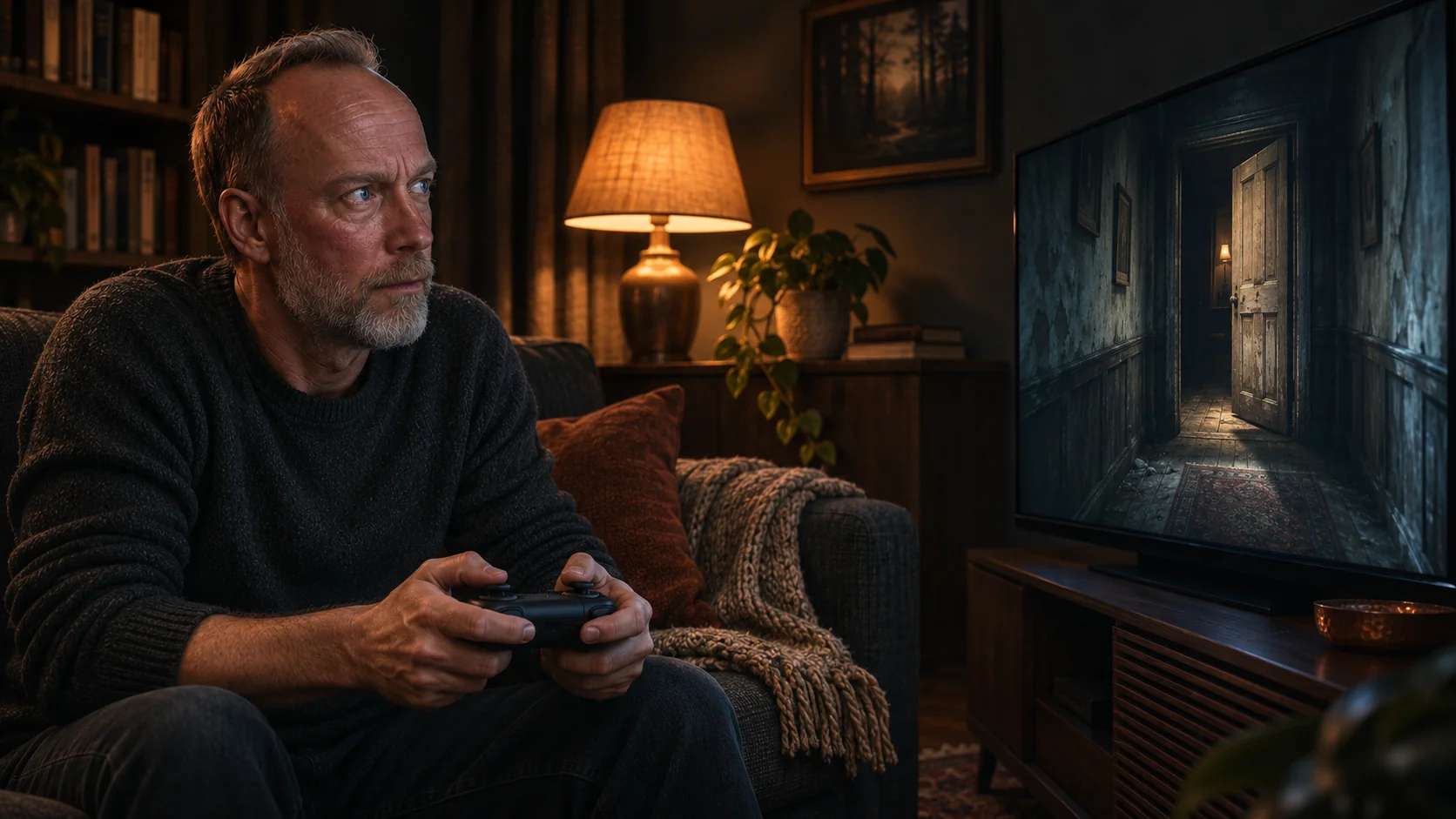
In the cinema, Mario has often thought: don't go in there. Now he is on the sofa with a controller. The same sort of door stands in front of him. This time, no one goes in unless he does something.
In our fictional game scene, a narrow corridor ends at a door handle. A crooked picture hangs on the left. On the right stands a wardrobe that looks very much like a hiding place. Mario turns the character around. The corridor behind it is empty. He turns it back. The door is patient.
He checks the buttons. Walk, look, grab. There is no button for “send someone else in first.” The little lamp glows in the living room. The cup on the coffee table is warm. On the screen, the light flickers.
Mario puts his thumb on the button. Then takes it off again. Nothing has actually happened yet. Still, somewhere along the way, a door has become a decision.
Being able to act does not mean deciding everything.
Agency here means the experienced scope for action in a game: being able to pursue intentions and act effectively. A game sets limits. Perhaps a door can be opened, but no window. Perhaps the character can escape, but cannot defend itself.
Boonen and Mieritz analyzed six horror games and described how the player character's traits, the rules of the game world, and players' abilities limit or open up agency. This is a qualitative game analysis, not a measurement of fear in everyone who plays those games. Analysis [21]
In our scene, freedom of choice initially increases Mario's hesitation. He can put off the moment, but he also has to bring it about himself. The cozy room outside the screen remains a different place from the corridor in the game.
More physiological arousal does not automatically mean more reported fear.
Madsen compared playing a horror game with watching a recorded gameplay sequence. In the analyzed sample of 50 male students, skin conductance, breathing rate, and heart rate increased more during play. Self-reported fear, however, showed no statistically significant group difference. Study [22]
The limited sample and the single game studied allow no general ranking of “playing is scarier.” The different measurement results are precisely what makes this interesting: participation changes the situation, but bodily response and conscious description are not the same. More control guarantees neither less nor more fear here.
Sometimes one small step is enough.
Mario presses. The door opens slowly. Behind it lies a little room with a desk. No monster. No bang. Just a key pointing toward the next corridor. Mario finds that a rather outrageous answer.
He takes the key and pauses. The lamp in the living room glows as before. Next time, he decides, someone may watch. Not because he needs help. Of course not. But because someone ought to witness how suspiciously sensible he has been about this door.
Sources: Boonen & Mieritz (2018) [21] · Madsen (2016) [22]. Reviewed by the editors on November 6, 2026; not independently reviewed by subject-matter experts.